The Honest Truth
Yes, we're a dispatch company. Yes, we want your business. But we also know that dispatch isn't the right choice for every carrier in every situation. This guide gives you the real comparison so you can make an informed decision — even if that decision is "not right now."
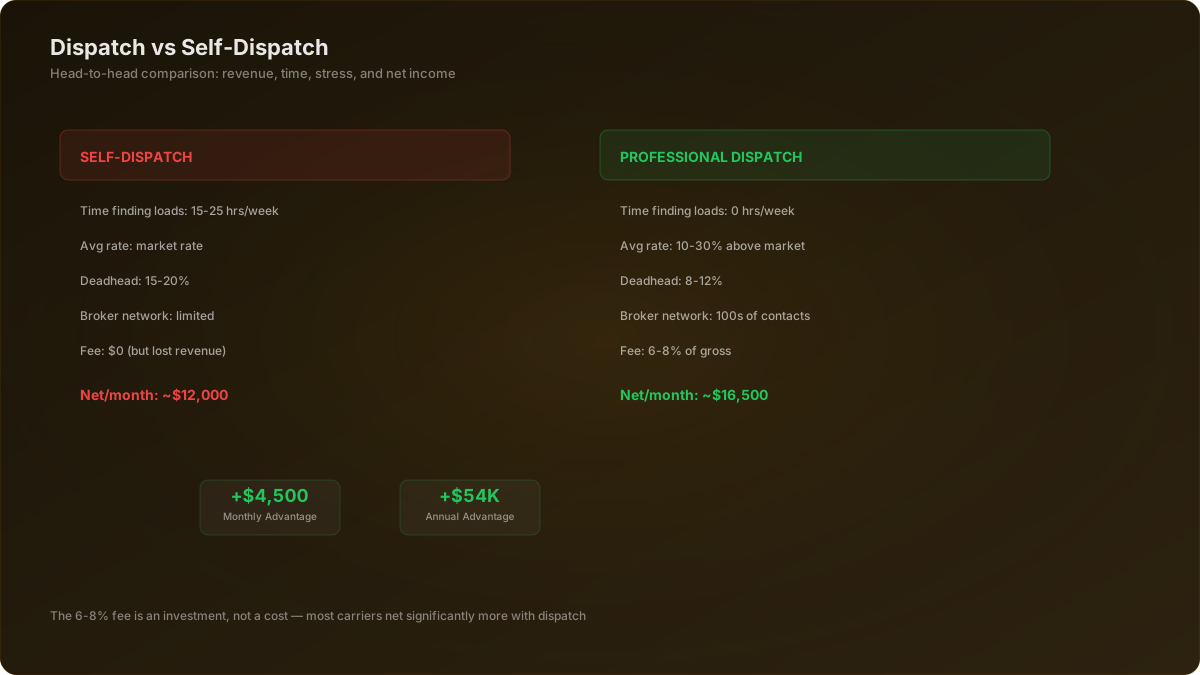
The bottom line upfront: for most owner-operators and small fleets, professional dispatch generates significantly more net revenue than self-dispatching — a trend backed by rate data from DAT Freight & Analytics, the industry's largest freight marketplace. But there are situations where self-dispatch makes sense, and we'll cover those too.
Side-by-Side Comparison
| Factor | Self-Dispatch | Dispatch Service |
|---|---|---|
| Cost | Load board subscription ($40-150/mo) | 4-8% of gross load revenue |
| Time Investment | 2-4 hours/day (15-25 hrs/week) | Minimal — review and approve loads |
| Rate Negotiation | You negotiate every rate | Dispatcher negotiates on your behalf |
| Market Knowledge | Limited to your experience | Professional, full-time market monitoring |
| Broker Relationships | Build over time, limited scale | Established network, hundreds of contacts |
| Paperwork | You handle everything | Dispatcher manages documentation |
| Deadhead Planning | Manual planning | Professional route optimization |
| Control | 100% — you choose everything | 95% — you approve, they recommend |
| Typical Net Revenue | Baseline | 15-25% above self-dispatch baseline |
The Revenue Math
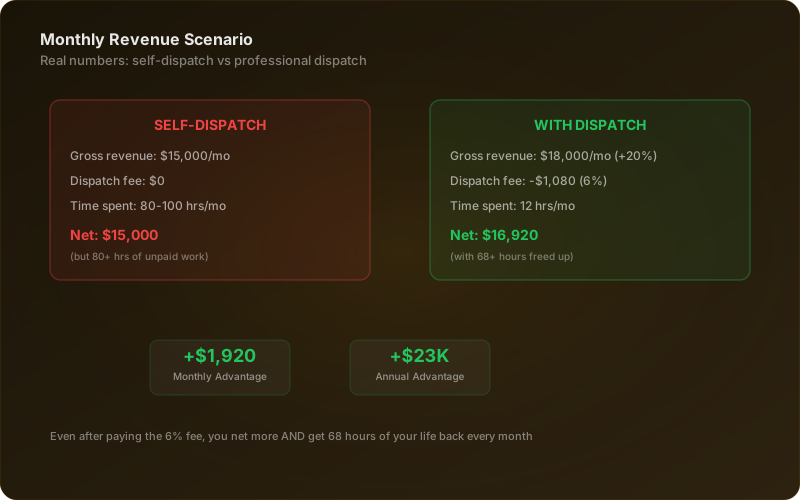
Let's run a realistic scenario for an owner-operator running 10,000 miles per month:
Self-Dispatching
With Dispatch Service
Net difference: +$4,795/month — In this scenario, the dispatch service costs $1,920/month but generates $4,795 more in effective revenue through better rates and less deadhead. That's a 2.5× return on the dispatch fee. Freight market analytics from FreightWaves consistently show that carriers with professional rate negotiation outperform spot-market averages.
When Self-Dispatching Makes Sense
We wouldn't be honest if we said dispatch is always the right answer. Self-dispatching can work well when:
- You have established direct shipper relationships that provide consistent, high-paying freight
- You run dedicated lanes with predictable freight and have deep knowledge of those specific markets
- You genuinely enjoy the business side — load searching, negotiating, and paperwork are activities you find fulfilling
- You're an experienced negotiator who consistently achieves top-market rates on your own
- You run local or short-haul routes where the operational complexity is low
If three or more of these apply to you, self-dispatching might be the better choice — at least for now.
When Dispatch Service Is the Clear Winner
- You're new to the industry — dispatchers have market knowledge that takes years to build
- You'd rather be driving than office work — every hour on load boards is an hour not earning
- Your deadhead is consistently above 12-15% — dispatchers reduce this significantly
- You don't have broker relationships — dispatchers bring established networks
- You want to scale to multiple trucks — dispatch becomes essential for fleet operations
- You're accepting below-market rates because you lack negotiation skills or market data — platforms like Truckstop.com provide rate tools, but a dispatcher interprets and acts on that data for you full-time
The Hybrid Approach
It doesn't have to be all or nothing. Many successful carriers use a hybrid model — self-dispatching the lanes they know inside and out while using a professional dispatch service for unfamiliar markets, seasonal surges, or fleet expansion. This lets you keep the control and margin on freight you can handle efficiently while tapping into a dispatcher's expertise where it matters most.
The key to making hybrid work is clear boundaries. Decide which freight categories you handle and which your dispatcher handles, then track the numbers separately. After 60-90 days, compare rate per mile, deadhead percentage, and hours invested for each method. The data will tell you whether to shift more freight to dispatch or keep the split where it is.
Base Lanes You Know
Keep self-dispatching freight on your home lanes where you have direct shipper relationships, know the brokers, and consistently hit top-market rates. These are your bread-and-butter runs — no dispatch fee needed when you already have the edge.
New Territory
Hand off unfamiliar regions to your dispatcher. They know which brokers pay well in markets you've never run, which lanes have hidden deadhead traps, and where backhaul opportunities exist. This is where dispatch earns its fee fastest.
Seasonal Overflow
During produce season, holiday freight surges, or capacity crunches, there's more high-paying freight than you can find alone. A dispatcher with real-time market access can stack premium loads during peak windows — exactly when every extra dollar per mile counts most.
Breakeven Analysis by Equipment Type
Not all equipment is created equal when it comes to the dispatch-vs-self-dispatch decision. Specialized freight commands higher rates and wider rate spreads — meaning a skilled dispatcher can negotiate significantly more than a solo carrier on the same lane. Here's how the numbers break down by equipment type based on national averages:
| Equipment Type | Avg Self-Dispatch Rate | Avg Dispatched Rate | Dispatch Fee | Monthly Breakeven |
|---|---|---|---|---|
| Dry Van | $2.45/mi | $2.80/mi | 6% | ~4,800 mi/mo |
| Reefer | $2.90/mi | $3.35/mi | 6% | ~4,200 mi/mo |
| Flatbed | $3.10/mi | $3.60/mi | 7% | ~4,500 mi/mo |
| Step Deck | $3.25/mi | $3.80/mi | 7% | ~4,100 mi/mo |
| Hotshot | $2.20/mi | $2.65/mi | 6% | ~3,800 mi/mo |
| Box Truck | $1.85/mi | $2.25/mi | 5% | ~5,200 mi/mo |
How to read this table: The "Monthly Breakeven" column shows how many miles you need to run before the dispatcher's higher rates cover their fee. Below that mileage, self-dispatch may cost less. Above it, dispatched freight nets more — and the gap widens with every additional mile. Most full-time owner-operators run 8,000-11,000 miles monthly, well above every breakeven shown here.
5 Signs You've Outgrown Self-Dispatching
Self-dispatching can work early in your career — but there comes a point where it actively holds your business back. If you recognize three or more of these signs, it may be time to bring in professional dispatch support:
3+ Hours a Day on Load Boards
If you're spending 15-25 hours per week searching for freight, calling brokers, and comparing rates, that's the equivalent of a part-time job — unpaid. Those hours could be spent driving revenue miles or getting the rest you need to stay safe on the road.
Deadhead Over 15%
Consistent deadhead above 15% means you're burning fuel and hours without revenue. Professional dispatchers reduce deadhead to 8-10% on average by planning backhauls before your current load even delivers. Every empty mile is money leaving your pocket.
Declining Loads Due to Time
When you're turning down freight — not because the rate is bad, but because you don't have time to vet the broker, check the lane, and negotiate — you're leaving money on the table. A dispatcher handles that legwork instantly so you never miss good freight.
Missing Seasonal Rate Peaks
Produce season, holiday freight, weather-driven surges — these windows can mean $1-2+ extra per mile, but only if you're positioned in the right market at the right time. Dispatchers monitor rate trends daily and reposition you proactively to capture peak rates before they disappear.
Turning Down Fleet Growth
If you've thought about adding a second or third truck but can't imagine finding loads for multiple drivers while managing your own freight, that's the ceiling of self-dispatch. A dispatch service scales with your fleet — adding trucks means adding revenue, not more administrative burden on you.
Related Resources
- Our Pricing — Transparent dispatch fees starting at 6% per load
- Our Services — Equipment types we dispatch and what's included
- Cost Per Mile Calculator — Know your breakeven rate before comparing options
- DAT Load Board — The most widely used freight marketplace
- Dispatch Fees Explained — What dispatch fees cover and how they work
- Load Boards vs Dispatch vs Brokers — Compare all three freight-finding methods
- Percentage vs Flat Rate Dispatch — Which dispatch fee structure puts more money in your pocket
Truck Dispatch Experts
Published Jul 15, 2025 · Updated Mar 3, 2026