What Is IFTA?
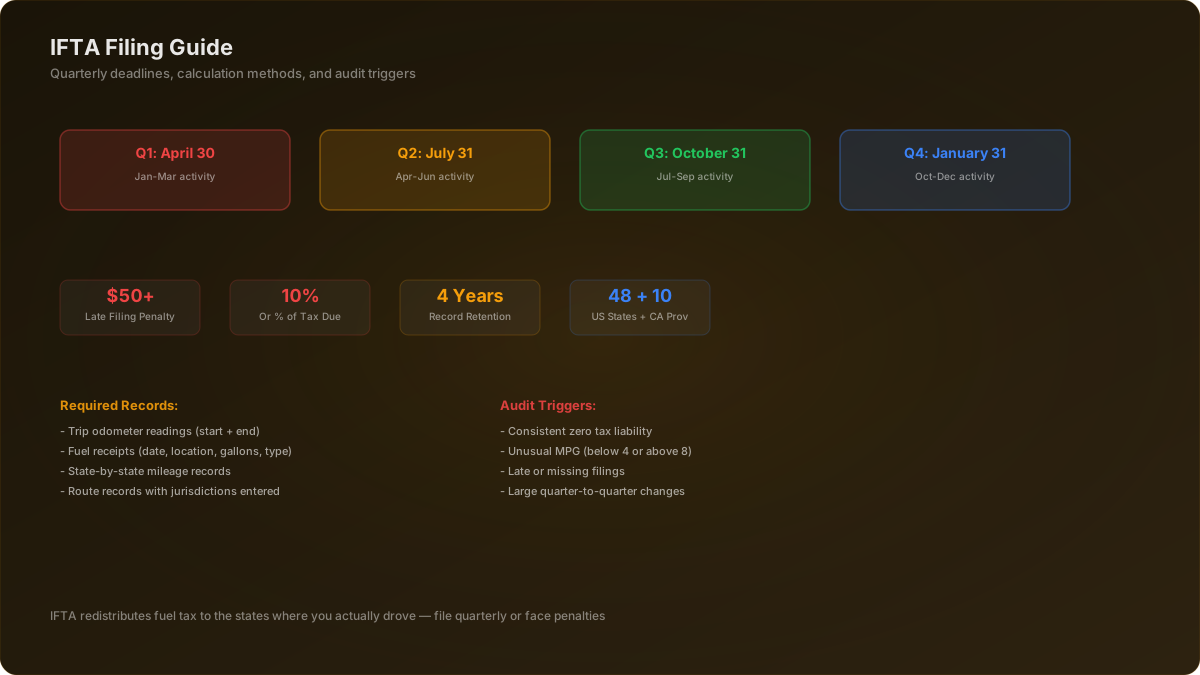
IFTA (International Fuel Tax Agreement) is an agreement between 48 US states and 10 Canadian provinces that simplifies fuel tax reporting for interstate carriers. Instead of filing separate fuel tax returns with each state you drive through, IFTA lets you file one quarterly return through your base (home) jurisdiction, which then distributes taxes to the other states.
You need an IFTA license if you operate a qualified motor vehicle — any vehicle used, designed, or maintained for transportation of persons or property and that has two axles and a gross vehicle weight or registered gross vehicle weight exceeding 26,000 pounds, or has three or more axles regardless of weight, or is used in combination when the combined weight exceeds 26,000 pounds.
Quarterly Filing Deadlines
Q1
Jan - Mar
Due: April 30
Q2
Apr - Jun
Due: July 31
Q3
Jul - Sep
Due: October 31
Q4
Oct - Dec
Due: January 31
Late returns incur a $50 minimum penalty or 10% of net tax due (whichever is greater), plus monthly interest on unpaid balances.
Step-by-Step: Filing Your IFTA Return
Gather Your Records
Collect all fuel receipts and trip records for the quarter. You need: fuel purchase receipts (date, location, gallons, amount), odometer readings at the start and end of each trip, and mileage by state/province for each trip.
Calculate Miles Per State
Total your miles driven in each IFTA jurisdiction. Use GPS records, ELD data, or trip sheets. Be accurate — discrepancies between reported mileage and what your truck's systems show are a top audit trigger.
Calculate Total Fuel Purchased Per State
Total gallons of fuel purchased in each state. Your fuel receipts must show the state of purchase. Credit card statements alone are not sufficient — you need actual receipts.
Determine Your Fleet MPG
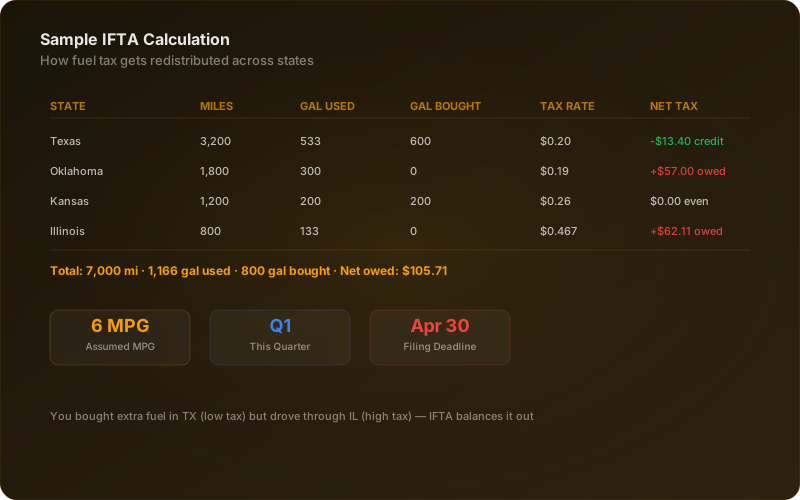
Divide total miles driven by total gallons consumed: Total Miles ÷ Total Gallons = Fleet MPG. This is your overall fleet fuel efficiency for the quarter. Most loaded semis average 5.5-7.0 MPG.
Calculate Taxable Gallons Per State
For each state: Miles in State ÷ Fleet MPG = Taxable Gallons. This represents the fuel you theoretically consumed in that state based on your fleet efficiency.
Calculate Net Tax Per State
(Taxable Gallons - Purchased Gallons) × State Tax Rate = Net Tax. If positive, you owe that state. If negative, you get a credit (you bought more fuel there than you consumed).
File Through Your Base Jurisdiction
Submit your return through your home state's IFTA portal. Most states have online filing systems. Pay any net tax owed. Credits from one state offset taxes owed to another.
Try our free tool: Use our IFTA Tax Calculator to estimate your quarterly tax before filing. Enter miles and gallons per state to see what you'll owe or be credited.
Common Mistakes That Trigger Audits
IFTA audits examine 4 years of records. These mistakes put you on the radar:
Unrealistic MPG
Reporting 9+ MPG for a loaded semi is a red flag. Auditors know realistic ranges by equipment type.
Missing Fuel Receipts
You need receipts for every fuel purchase. No receipt = no credit for that purchase during an audit.
Estimated Mileage
Using round numbers or estimates instead of actual mileage data signals inaccuracy to auditors.
Consistent Zero Liability
Filing returns showing $0 owed quarter after quarter is unusual and draws attention.
Record-Keeping Best Practices
- Keep all fuel receipts for 4 years minimum — that's the IFTA audit lookback period
- Use a fuel card that provides detailed reporting by state and date
- Record odometer readings at every state line crossing
- Use your ELD data to verify state-by-state mileage
- Scan or photograph paper receipts as backup — paper fades
- Reconcile your records monthly, not just at quarter end
Many trucking accounting software programs (like Motive and ATBS) can automate much of the IFTA tracking process using ELD integration and fuel card data.
IFTA Tax Rates by State (2026)
Diesel fuel tax rates vary significantly by state, which directly impacts your IFTA settlement. States with higher tax rates mean higher taxable liability for miles driven there — and bigger credits when you purchase fuel there. Here are the current diesel tax rates for key trucking states:
| State | Diesel Tax Rate (per gallon) | Notes |
|---|---|---|
| California | $0.6810 | Highest in the nation — includes excise + sales tax on diesel |
| Pennsylvania | $0.5770 | Second highest; Oil Company Franchise Tax included |
| New York | $0.4025 | Plus supplemental HUT for heavy vehicles (see below) |
| Illinois | $0.4670 | Includes state + underground storage tank fees |
| Indiana | $0.5400 | Surcharge adjusted quarterly based on fuel prices |
| Ohio | $0.4700 | Increased in 2019, stable since |
| North Carolina | $0.4020 | Adjusted semi-annually based on wholesale price |
| Georgia | $0.3540 | Includes prepaid local tax |
| Tennessee | $0.2700 | One of the lowest — popular fueling stop for this reason |
| Texas | $0.2000 | Flat rate, no additional surcharges |
| Florida | $0.3587 | Includes state + county + inspection fees |
| Missouri | $0.2450 | Recently increased; was $0.17 for decades |
Rates change quarterly. IFTA tax rates are updated each quarter by individual states. Always verify current rates through your base jurisdiction or the IFTA Tax Rate Matrix. Use our IFTA Tax Calculator to estimate your quarterly liability using the latest rates.
States with Additional Fuel Taxes & Fees
Most states use a straightforward per-gallon diesel tax, but four states impose additional or alternative taxes on heavy vehicles that fall outside normal IFTA reporting. If you run through these states regularly, you need to know about these separate obligations.
Oregon — Weight-Mile Tax
Oregon does not charge a per-gallon diesel fuel tax. Instead, heavy vehicles (over 26,000 lbs) pay a weight-mile tax based on miles driven and registered weight. You must file separate Oregon weight-mile tax reports — this is not included in your IFTA return. Oregon fuel purchases still appear on IFTA but with a $0.00 tax rate.
Kentucky — KYU Tax
Kentucky imposes a weight-distance tax (KYU) on trucks with a combined gross weight over 59,999 lbs. This is a separate filing from IFTA — you need a Kentucky KYU number and must report miles driven in Kentucky quarterly. The rate is based on your registered weight class. Non-compliance results in roadside citations and fines.
New York — Highway Use Tax (HUT)
New York charges a Highway Use Tax (HUT) on trucks over 18,000 lbs using New York highways. This is assessed based on miles driven and gross weight, in addition to the standard IFTA fuel tax. You must register with the NY Department of Taxation and file HUT returns separately. A HUT certificate must be carried in the vehicle.
New Mexico — Weight-Distance Tax
New Mexico charges a weight-distance tax on vehicles over 26,000 lbs GVW. Like Oregon and Kentucky, this is filed separately from your IFTA return. You need a New Mexico weight-distance permit, and the tax is based on miles driven within New Mexico multiplied by a rate tied to your declared gross weight. Permits must be carried in the cab at all times.
These additional state taxes are separate from IFTA and require their own registration, reporting, and payment. Missing these filings is a common mistake for carriers new to interstate operations.
How ELDs Simplify IFTA Tracking
Electronic Logging Devices (ELDs) have transformed IFTA compliance from a manual headache into a largely automated process. Modern ELDs from providers like Motive, Samsara, and Garmin do far more than track hours of service — they can handle the bulk of your IFTA record-keeping automatically.
Here's what a good ELD does for IFTA:
- Automatic state line detection — GPS tracks when you cross state borders, eliminating manual odometer logs
- Miles-per-state reports — Generates jurisdiction-by-jurisdiction mileage breakdowns ready for your IFTA return
- IFTA-ready exports — Many ELDs export data in formats compatible with IFTA filing portals or accounting software
- Fuel card integration — Links fuel purchases to specific trips and locations for automatic receipt matching
- MPG tracking — Calculates real-time fleet fuel efficiency so you can spot discrepancies before filing
- Quarterly report generation — Some platforms (Motive, Samsara) generate complete IFTA-formatted quarterly reports with one click
- Audit-ready records — Digital records with GPS timestamps are far more defensible during an IFTA audit than handwritten logs
That said, ELD mileage data alone isn't enough to file your IFTA return. You still need fuel purchase receipts showing the date, location, gallons, and amount for every fill-up. The best approach is to pair your ELD's mileage tracking with a fuel card that provides detailed state-by-state purchase reports — together, these two data sources cover everything you need for accurate, audit-proof IFTA filing.
Related Resources
- FMCSA IFTA Information — Official IFTA registration and compliance details
- Fuel Cost Calculator — Estimate fuel expenses for any route
- IFTA Tax Calculator — Calculate your quarterly fuel tax obligation
- New Authority Checklist — Complete setup guide including IFTA licensing
- How to Start a Trucking Business — Complete startup guide for new owner-operators
- Dispatch Fees Explained — Understand what dispatch services cost and include
Truck Dispatch Experts
Published May 20, 2025 · Updated Mar 3, 2026