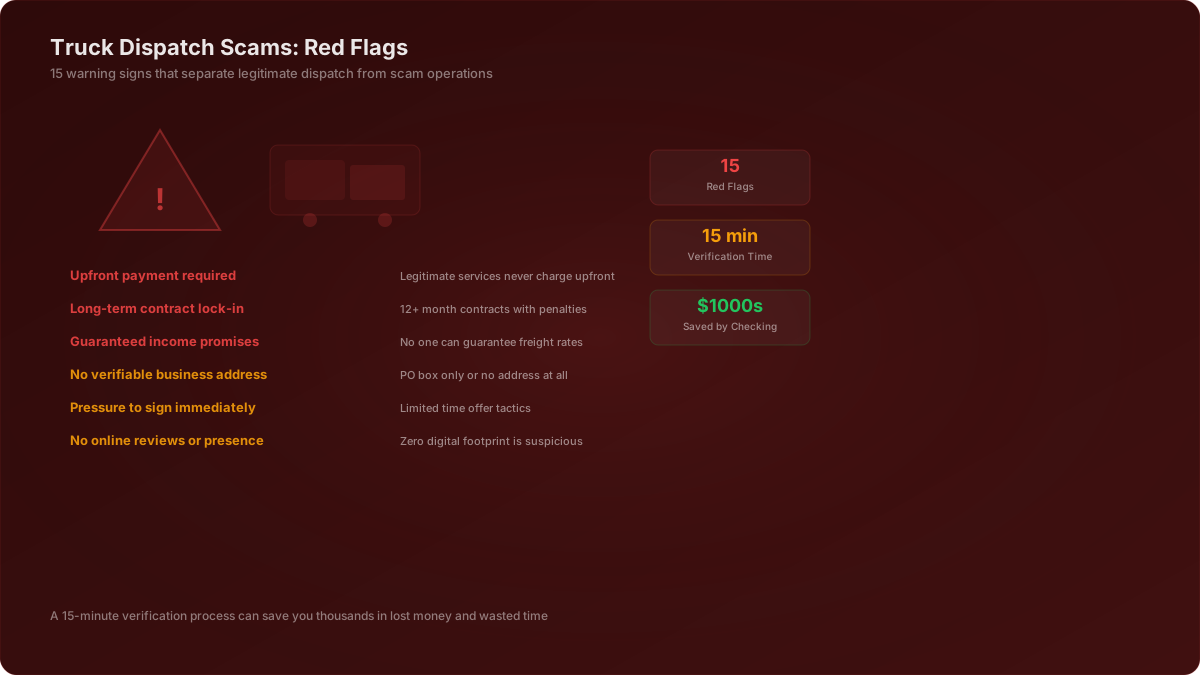
Short answer: The clearest signs of a truck dispatch scam are a large fee demanded before any load is booked, a guaranteed weekly income, no written fee schedule, and a request for your ELD login or bank access. The biggest one is structural: a service that books freight for several carriers and picks who hauls what is brokering, and under 49 CFR 371.2 and FMCSA's June 2023 guidance it must hold broker authority and a $75,000 security to do it legally.
Why Are Truck Dispatch Scams So Common?
Because the entry barrier is genuinely low — but not as low as most articles on this subject claim, and the difference matters. There is no dispatcher licence in federal law, no dispatcher exam and no dispatcher registry. Anyone can print business cards tomorrow. What is often stated next, and is simply wrong, is that dispatch is therefore unregulated.
It is not. FMCSA addressed dispatch services directly in its final guidance, Definitions of Broker and Bona Fide Agents, published at 88 FR 39368 on 16 June 2023. That guidance says dispatch services may be classified as either brokers or bona fide agents depending on the nature and scope of their activities. Where a service crosses into arranging transportation for multiple carriers and exercising discretion over which carrier gets a load, it is brokering, and 49 CFR 371.2 together with the registration requirement in 49 U.S.C. 13904 applies to it in full.
So the real gap is not an absence of rules. It is that almost no carrier checks which side of that line their dispatcher sits on, and a service operating on the wrong side has every incentive not to raise the subject. That is why it leads the list below.
The damage from a bad dispatcher is rarely only financial. Carriers lose weeks of productive time, hand over credentials they then have to unwind, and sometimes sign away enough control that recovering takes a season. The pattern, though, is predictable — which is exactly what makes it catchable.
This article is the vetting guide in our dispatch and load finding topic hub. If you are still deciding whether to use a dispatcher at all, start with how truck dispatch works or dispatch versus self-dispatch.
Is a Truck Dispatch Service Legal Without a License?
Yes — working as the bona fide agent of a motor carrier is lawful and is expressly contemplated in FMCSA guidance. No separate dispatcher licence exists or is required. What is unlawful is performing brokerage without registration. Under 49 U.S.C. 14916 a person may provide interstate brokerage services only if registered under section 13904 and in compliance with the financial security requirements of section 13906, and the civil penalty for doing it anyway runs up to $10,000 for each violation, applying jointly and severally to the corporate entity and to its individual officers, directors and principals.
One test decides which category a dispatch service falls into.
Sources: 49 CFR 371.2; FMCSA final guidance, Definitions of Broker and Bona Fide Agents, 88 FR 39368 (June 16, 2023); 49 CFR 387.307(a); 49 U.S.C. 14916.
Our FAQ covers the allocation-of-traffic test in more detail, and if you are considering starting a dispatch service yourself, the obligation runs the other way too — see how to become a truck dispatcher.
What Are the Red Flags of a Truck Dispatch Scam?
No single red flag proves a company is a scam — legitimate businesses make mistakes, and some of these are judgement calls. Two or three together from the same company is a pattern, and a pattern is enough to walk. They are ordered by consequence, not by how obvious they are.
1. Booking Freight for Multiple Carriers Without Broker Authority
This is the red flag almost nobody checks, and it is the most consequential one on the list. 49 CFR 371.2 defines a broker as a person who, for compensation, arranges or offers to arrange the transportation of property by an authorized motor carrier, and defines bona fide agents as persons who are part of the normal organization of a motor carrier and perform duties under the carrier's directions pursuant to a preexisting agreement. In its final guidance on Definitions of Broker and Bona Fide Agents (88 FR 39368, June 16, 2023), FMCSA stated that dispatch services may be classified as either brokers or bona fide agents depending on the nature and scope of their activities, and defined allocating traffic as any exercise of discretion on an agent's part when assigning a load to a motor carrier. A service that keeps a stable of carriers and decides which one gets a given load is brokering, whatever it calls itself. FMCSA's guidance adds that if the dispatch service is deemed to be providing unauthorized brokerage services under 49 U.S.C. 14916, the service will be subject to applicable penalties — up to $10,000 per violation, applying jointly and severally to the company and to its individual officers, directors and principals. Ask one direct question before you sign: am I hiring you as my appointed agent under a written agreement, or are you brokering? Then ask to see the agreement.
2. No Written Contract or Vague Agreement Terms
A legitimate dispatch company provides a written agreement that spells out the fee structure, payment schedule, services included, termination terms and dispute process. If a dispatcher says they will work it out as you go, or sends a one-paragraph agreement with no specifics, that is not a casual business style — it is a setup for disputes you cannot win. Without terms in writing you have no way to show what was promised when fees change, services quietly disappear, or payments get held. The agreement also settles the question in red flag 1: it is where an appointment as your bona fide agent is either documented or conspicuously absent.
3. Large Upfront Setup Fees Demanded Before Any Load Is Booked
Onboarding a carrier involves real administrative work — building broker packets, configuring system access, processing documents — and a modest fee for it can be reasonable. The warning sign is scale and timing. When a dispatch company wants hundreds or thousands of dollars before it has found you a single load, the fee is the business model rather than a cost recovery. A service confident in its own dispatching earns far more from ongoing percentages than from admission charges, which is why many established dispatchers, ourselves included, charge nothing to onboard. A large fee collected upfront means the company already has its revenue whether or not it ever performs.
4. Long-Term Lock-In with a Heavy Early Termination Penalty
Some dispatch companies bind carriers to 6- or 12-month terms with an early termination penalty attached, sometimes running well into four figures. There is no industry standard notice period to measure this against, so judge it by incentive: a company that keeps carriers through results does not need a penalty clause to keep them, and a company that needs one is telling you what it expects your experience to be. Prefer month-to-month terms. Read the termination clause before the fee schedule — it is the part you will care about most if the relationship goes wrong. Our own pricing has no contract to break at all.
5. Guaranteed Income or Specific Revenue Promises
"We guarantee $8,000 per week" or "our carriers make $250,000 a year" are among the clearest signals in truck dispatch. No honest dispatcher can guarantee income, because rates move with market conditions, seasonal demand, fuel prices and lane availability, none of which the dispatcher controls. A good one will talk in ranges: typical rates for your equipment in your lanes, what the market has been doing, what is realistic. That is a forecast with error bars, and it is what an honest answer sounds like. A specific promised number is either a closing tactic or a fee-collection operation that does not depend on dispatching you at all.
6. Won't Share Their Legal Name, Address, or MC Number
Ask for the company's legal name, state of registration, physical business address, and MC number if they hold broker authority. All of it should arrive immediately, because none of it is confidential — the MC number is published in a federal database. Deflection, a claim that the company is private, or an insistence that the information is proprietary usually means one of two things: the operation is not registered, or it has been reported before under a name you would find. Verify anything you are given on FMCSA's SAFER System and on your state's Secretary of State business registry rather than taking it on trust.
7. They Want Your ELD Login or Bank Account Access
These are two things no dispatcher needs. A dispatcher needs your available hours and your location, and both can be shared read-only or in a thirty-second phone call. Handing over ELD credentials means another party can edit your duty status, and 49 CFR 395.8(e)(1) is explicit: no driver or motor carrier may make a false report in connection with a duty status. Note who that binds — the motor carrier as well as the driver. A falsified log created by someone with your login becomes your company's violation to answer for, not theirs. Direct bank access is worse and has no dispatch function whatsoever. Neither is a grey area.
8. Pressure to Sign Immediately
"We only have two spots left." "This rate is only good if you sign today." These are high-pressure closing tactics borrowed from retail, and they have no place in a professional service relationship that is supposed to last years. A legitimate dispatcher benefits from you reading the contract, calling references and deciding with confidence, because informed carriers stay. Urgency is manufactured for one reason: the pitch does not survive a day of checking. If taking twenty-four hours to search the company name and call two references would cost you the deal, the deal was the problem.
9. No Verifiable Business Presence — Only Social Media DMs
Dispatch is genuinely remote work and plenty of excellent dispatchers run from home offices, so the absence of a storefront proves nothing. What should be verifiable is the business: a company registered with a state, an address, a company email domain rather than a free webmail account, and a phone line someone answers during business hours. When the only address is a PO box, calls go to voicemail during the working day, and the entire relationship happens in Instagram or WhatsApp messages, you are not dealing with a company — you are dealing with an individual who can vanish, taking the only record of your agreement with them. Professional dispatch generates rate confirmations, documented agreements and an audit trail, and none of that survives in a DM thread.
10. A Pattern of Complaints About Withheld Payments or Surprise Fees
Before signing, search the company name alongside reviews, complaints and scam, and check the Better Business Bureau complaint database and owner-operator communities. Every company collects an unhappy review eventually, so a single complaint tells you very little. A pattern tells you a great deal, particularly when the complaints repeat the same specifics: money held back, fees that were never in the agreement, aggressive collection of termination penalties. Read the company's responses as carefully as the complaints. A professional reply to a bad review is more reassuring than a wall of five-star ratings, and an attack on the reviewer is its own answer.
11. Charging You Separately for "Load Access" or Broker Relationships
In the normal model the dispatcher finds loads, you haul them, and the dispatcher takes a percentage of the gross. You should not also be paying to access loads, paying a broker introduction fee, or buying a load package. Load board access is something you can simply buy: DAT publishes its carrier plans openly at $59 a month for DAT One Standard, $149 Enhanced, $169 Pro, $259 Select and $339 Office (dat.com/load-boards/pricing, checked August 2026). If a dispatcher charges a separate monthly fee to reach loads on top of a dispatch percentage, ask precisely what that fee buys that a direct subscription does not. Usually the answer is nothing, and you are paying twice for the same access.
12. Evasive About How Many Trucks Your Dispatcher Actually Carries
There is no federal rule and no real industry standard for trucks per dispatcher, and you will find every number between five and thirty quoted as though it were settled. Because no benchmark exists, the number a company gives you matters less than its willingness to give one. Ask specifically: how many trucks does the dispatcher assigned to me carry right now, and do I get a named dispatcher or whoever answers the queue? A company that answers plainly has told you how much attention your loads will receive. A company that will not answer, or that cannot say who your dispatcher is, has told you the same thing less directly.
13. No Load Details Before You Are Asked to Accept
Before you commit to a load you should know origin and destination, pickup and delivery windows, commodity, weight, the rate and total pay, and any special requirements such as appointments, lumper fees or team service. A dispatcher who books first and explains afterwards, or who asks you to trust that the load is good, is withholding something specific: the rate is below what was implied, detention is likely, or the receiver is known for long waits. Full disclosure before acceptance is not a courtesy — it is the basis of the relationship, and it is the failure this whole list exists to help you catch.
14. Mandatory Use of a Factoring Company They Control
Some dispatch companies require you to factor through a specific company, often one they own or are paid to refer you to. The rate itself is usually not the tell. Our own freight factoring guide puts spot factoring at 3-5% and contract factoring at 1-3%, so a 3-5% quote is ordinary pricing for the more flexible product rather than proof of a kickback. The abuse is structural. It is being unable to change factors without also losing dispatch, and a referral fee flowing to your dispatcher that is never disclosed to you. Put two questions in writing before signing: can I cancel factoring independently of dispatch, and do you receive any compensation from this factoring company?
15. An Ultra-Low Headline Rate Sitting on a Stack of Add-On Fees
A 1-3% dispatch fee sounds remarkable until the technology fee, compliance fee, per-broker setup charge, rate confirmation processing fee and after-hours support fee arrive alongside it. Run the arithmetic yourself before signing. Take a carrier grossing $10,000 a week across four loads, and suppose the add-ons are $75 a week for technology, $50 a week for compliance, $25 per new broker setup and $10 per rate confirmation. The 3% headline is $300. The weekly fees add $125, four rate confirmations add $40, and two new broker setups add $50. That is $515 a week, or about 5.2% of gross — not 3%. Those numbers are an illustration rather than a price list, but the method is the point. Ask the only question that resolves it: what is the total cost for a carrier grossing $10,000 a week, including every fee? An answer that will not resolve to a single number is the answer.
Red flag 13 is the one carriers catch too late. Learning how to read a rate confirmation makes withheld load details obvious in seconds, and what to do when detention goes unpaid covers the accessorial dodge that usually follows.
How Do I Check If a Dispatch Company Is Legitimate?
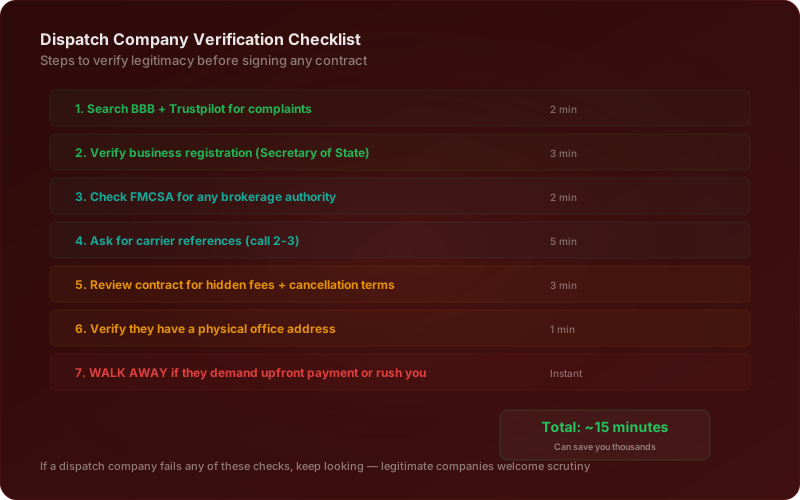
Run this before you hand over your carrier packet, sign anything, or pay a fee. It takes about 25 minutes end to end. For the wider selection framework — not just the fraud screen — see our guide to choosing a dispatch company, and our broker vetting checklist runs the same discipline against the brokers your loads come from.
1. Search the company name for complaints
5 minSearch the company name alongside scam, reviews and complaints. Check the Better Business Bureau at bbb.org, owner-operator communities and trucking forums. You are looking for a repeated pattern rather than a single unhappy carrier, and you are reading the company's replies as closely as the complaints.
2. Confirm the business is actually registered
3 minLook the company up on your state's Secretary of State business search, which every state publishes online. Confirm it is registered, when it was formed, and who the registered agent is. A dispatch operation with no registered entity behind it has no accountability and, often, no assets to pursue.
3. Settle whether they are your agent or a broker
2 minAsk directly whether they will act as your bona fide agent under a written agreement or are arranging freight as a broker. If they claim broker authority, verify the MC number on FMCSA's SAFER System and confirm the authority is active; FMCSA's Licensing & Insurance record names the surety or trust fund holding the required $75,000 security. If they book for several carriers and choose who hauls what but hold no broker authority, that is red flag 1 in front of you.
4. Request references and actually call them
5 minAsk for three to five current carriers and phone them. Ask about payment reliability, load quality, how quickly calls get returned, and whether any fee ever appeared that was not in the agreement. A company that cannot produce a single carrier willing to take your call has told you everything you need.
5. Read the agreement line by line
10 minRead every word before signing. Find the complete fee schedule rather than the headline rate, the termination clause and any penalty, exclusivity requirements, factoring mandates, and exactly which services are included versus billed separately. Ask for clarification in writing on anything ambiguous — a verbal reassurance is worth nothing later.
What Should Truck Dispatch Actually Cost?
Knowing the ordinary range helps you spot both ends of the distribution — the suspiciously cheap and the plainly overpriced. The figures below are observed market ranges, not a regulated standard; nobody publishes an official dispatch fee schedule. Our full pricing breakdown is in truck dispatch rates explained.
| Fee Type | Typical Market Range | Worth Questioning |
|---|---|---|
| Percentage (Semi) | 5-8% (budget services 4-5%) | Below 3% or above 10% |
| Percentage (Box/Hotshot) | 7-10% | Below 5% or above 15% |
| Flat Rate (Weekly) | $150-400/wk | Below $100 or above $600 |
| Setup/Onboarding Fee | $0-200 | Anything demanded before a first load |
| Contract Length | No contract, or month-to-month | 6-12 months with a penalty |
| Termination Fee | $0 | Any penalty for leaving |
| Load board access | Buy direct — DAT carrier plans $59-$339/mo | A separate "load access" fee on top of a percentage |
DAT carrier plan pricing per dat.com/load-boards/pricing, checked August 2026: DAT One Standard $59, Enhanced $149, Pro $169, Select $259, Office $339 per month. Compare boards in DAT vs Truckstop.
Bottom line: total cost decides this, not the headline rate. Using the worked example in red flag 15, a 3% quote carrying $125 a week in fixed fees plus per-load and per-broker charges came to about 5.2% of a $10,000 week — more than a flat 5% with nothing attached. Ask every provider the same question and compare the single number that comes back.
What to Do If You Have Been Scammed by a Dispatch Company
If you have already signed or already lost money, work through these in order. The first two are urgent; the rest build the record that everything else depends on. If the money is stuck on the broker side rather than the dispatcher side, see what to do when a broker is not paying and our bad freight broker action plan.
Document everything before it disappears
Save contracts, messages, emails, payment receipts and screenshots. If the relationship ran through social media, screenshot every conversation now, while the account still exists. Every step below depends on this documentation.
Revoke every access you granted
Change passwords on your ELD, load boards, email and any system the dispatcher touched. Contact your bank if you shared financial details, and notify your factoring company. Do this first and immediately — it is the only step that stops ongoing damage.
Send a formal written demand
If money is owed, send a demand letter by email and by certified mail to every known address. State the amount, the terms supporting the claim, and a deadline. This creates the record every later step relies on.
File with the FTC
Report at reportfraud.ftc.gov. The FTC tracks patterns across complaints and shares reports with law enforcement, so a filing that feels futile on its own contributes to a case that is not.
File with FMCSA's National Consumer Complaint Database
Use nccdb.fmcsa.dot.gov for broker fraud, non-payment and transportation violations. This is the federal channel specific to our industry, and it is the right place for a complaint about a dispatch service operating as an unregistered broker.
Report to the Better Business Bureau
File at bbb.org. BBB complaints are public and surface in search results, which is precisely how the next carrier researching that company will find your warning.
Claim against the $75,000 security if they held broker authority
49 CFR 387.307(a) requires a broker to keep a surety bond or trust fund in effect for $75,000, filed on Form BMC-84 or BMC-85, and the instrument exists to provide payments to shippers or motor carriers if the broker fails to carry out its contracts, agreements or arrangements. Look up the surety company or trust fund institution in FMCSA's Licensing & Insurance record and file the claim with that company. FMCSA records the security but does not adjudicate or pay claims against it.
Warn other carriers, factually
Post what happened in owner-operator communities and reviews. State the facts — dates, amounts, what was promised, how the company responded. Factual accounts are both more useful and more durable than angry ones.
Talk to a transportation attorney once the amount justifies it
When the sum owed is large enough that a filing fee and an attorney's hours are worth spending, make the call. Some transportation attorneys offer a free initial consultation, and if the company also held broker authority you may have remedies beyond the bond claim.
Where to Verify and Report a Truck Dispatch Scam
All four are free, public and run by a government agency or an independent body. None of them require you to be a member of anything.
Verify broker and carrier authority, MC numbers and operating authority status. FMCSA's separate Licensing & Insurance system is where the surety company or trust fund holding a broker's $75,000 security is named — that is where a bond claim is actually filed
File complaints about broker fraud, non-payment, unregistered brokerage and other transportation violations
File complaints about business fraud and deceptive practices; the FTC tracks patterns and shares reports with law enforcement
Check company profiles, read complaint history, and file a complaint that is publicly visible
What Does a Legitimate Dispatch Company Look Like?
Inverting the list is useful, because the honest version of each red flag is concrete and checkable rather than a vague promise of professionalism.
Terms you can read before you commit
Every fee, service, notice period and responsibility is written down and handed over before you sign, including whether the relationship is agency or brokerage. Nothing important is verbal.
Their revenue depends on yours
A percentage-based dispatcher earns more only when you gross more, which aligns the incentive precisely. A fee-first operation is paid the same whether your truck moves or not.
You can leave
Month-to-month terms, or no contract at all. A company that retains carriers by performing does not need a penalty clause. Ours has no contract to break and no cancellation fee.
A real communication trail
Company email domains, a phone line answered in business hours, dispatch software, and documented rate confirmations. Every interaction leaves a record you can produce later.
A dispatcher with a name
You know who is assigned to your truck and can reach that person, rather than whoever happens to pick up the queue. They will tell you their current truck count if you ask.
Full load detail before acceptance
Origin, destination, rate, commodity, weight and special requirements in front of you before you say yes. No load is ever booked in your name without your approval.
Where we stand on our own list: every band in the table above brackets our published pricing — 6% or $250 a week flat for semi truck equipment, 8% or $350 for box truck, sprinter van and hotshot, with no setup fee, no contract and no cancellation fee. We publish it precisely because "ask for the total cost in writing" is not advice we would give if our own answer were complicated. It is all on the pricing page.
Related Resources
- Dispatch & Load Finding hub — every guide on finding freight and choosing a dispatcher, in one place
- How to Choose a Dispatch Company — the selection framework, once a company has cleared this fraud screen
- Truck Dispatch Fees Explained — what percentage and flat-rate dispatch actually costs
- Freight Factoring Guide — read before agreeing to any mandated factor (red flag 14)
- Double Brokering Protection — the freight-side fraud that often accompanies dispatch fraud
- Load Boards vs Dispatch vs Brokers — how the three ways of sourcing freight actually differ
- New Authority Dispatch Guide — new carriers are targeted first; what to watch in your first 90 days
- Best Dispatch Companies 2026 — how to evaluate dispatch companies on reliability
- Truck Dispatch Not Working? — underperformance is not always fraud; how to tell the difference