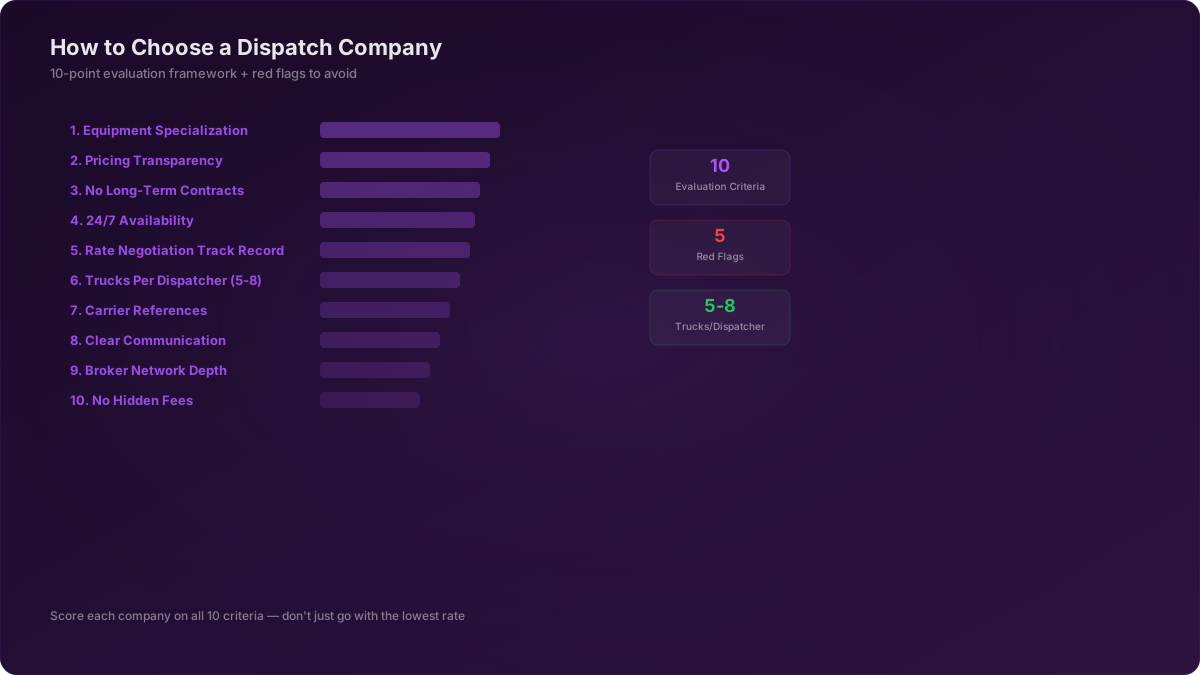
Why Your Choice of Dispatcher Matters
Your dispatch service directly controls your revenue, your miles, and your daily stress level. A great dispatcher can be the difference between grossing $12,000/month and $18,000/month. A bad one can burn through your cash reserves in weeks with low-paying loads and excessive deadhead.
The trucking dispatch industry has grown rapidly, and quality varies enormously. Some companies are run by veteran dispatchers with decades of experience. Others are startups with minimal freight market knowledge. This guide gives you a framework to tell the difference.
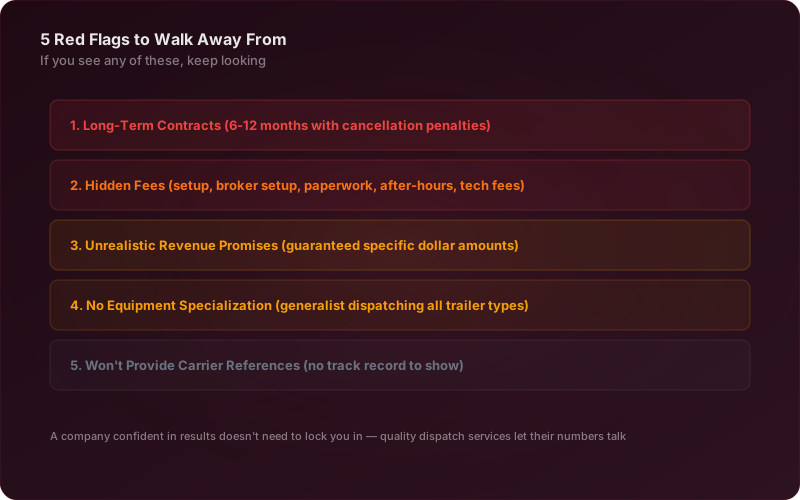
10 Criteria for Evaluating a Dispatch Company
Equipment Specialization
The most critical factor. Does the company have dispatchers who specialize in your trailer type? A dry van dispatcher who suddenly handles your reefer won't know temperature requirements, appointment windows, or which shippers pay premiums for temperature-controlled freight.
Pricing Transparency
Know exactly what you'll pay. Ask: Is it a percentage or flat fee? What percentage? Are there any additional fees (setup, technology, administrative)? When is payment due? Can charges change without notice? The best companies have simple, transparent pricing.
Contract Terms
Read every word. Beware of companies requiring 6-12 month contracts with early termination fees. Industry-leading services operate on month-to-month or no-contract terms because their performance speaks for itself. A 30-day notice period is standard and reasonable.
Communication & Availability
How will your dispatcher communicate with you? Phone, text, app, email? How quickly do they respond? Are they available on weekends and evenings? Test this during the evaluation — call their number at 8 PM on a Saturday. If no one answers, that tells you something.
Load Quality & Lane Expertise
Ask what load boards and shipper relationships they use. A company relying solely on one load board is limited. The best dispatchers use multiple boards (DAT, Truckstop, 123Loadboard) plus direct shipper contracts and established broker relationships.
Dispatcher-to-Truck Ratio
A dispatcher managing 5-8 trucks can give each one proper attention. More than 10 trucks per dispatcher means you're sharing attention with too many others. Ask specifically how many trucks your assigned dispatcher handles.
References from Similar Operations
Ask for references from carriers running the same equipment type in similar regions. A dispatch company might be excellent for dry van in the Southeast but terrible for flatbed in the Midwest. Relevance matters.
Track Record & Reputation
Check online reviews, trucking forums (Reddit r/Truckers, TheTruckersReport), and social media. But take online reviews with context — no company satisfies everyone. Look for patterns, not individual complaints.
Paperwork & Invoicing Support
Will they handle rate confirmations, BOLs, PODs, and invoicing? What about detention pay and accessorial charges? The best dispatch services handle all documentation and ensure you get paid for every billable service.
Technology & Reporting
Can you see your loads, rates, and performance metrics? Some companies provide dashboards or apps that give you visibility into your dispatch activity. This transparency helps you evaluate whether the service is delivering value.
Red Flags to Watch For
- ✗Guaranteed income promises — No legitimate dispatcher can guarantee specific revenue. Markets fluctuate.
- ✗Upfront setup fees — Quality companies don't charge to start. They earn through performance.
- ✗No equipment specialization — "We dispatch everything" often means "We're not expert in anything."
- ✗Demanding MC authority access — Your dispatcher should never need your FMCSA login credentials.
- ✗Poor onboarding communication — If they're slow or unresponsive before you sign up, it won't improve after.
Questions to Ask Before Signing Up
Print this list and use it when evaluating any dispatch company:
- What is your exact fee structure? Any additional charges?
- Do you specialize in my equipment type?
- How many trucks does my assigned dispatcher handle?
- What load boards and shipper relationships do you use?
- What are your contract terms? Can I leave at any time?
- Who handles paperwork and invoicing?
- What are your hours of operation? Weekend coverage?
- Can I speak with current carriers as references?
- How do you handle detention pay and accessorials?
- What reporting or visibility do I get on my loads?
A company that answers all of these confidently and transparently is worth trying. One that dodges or deflects on multiple questions is one to avoid. Ready to evaluate us? Check our transparent pricing or get started with a free consultation.
Types of Dispatch Companies
Not all dispatch companies operate the same way. Understanding the four main dispatch models helps you choose the one that fits your operation, budget, and level of involvement.
Full-Service Dispatch
Handles everything: load booking, rate negotiation, route planning, paperwork, detention claims, broker communication, and invoicing. You focus on driving while they manage the business side.
Best for: Owner-operators who want to maximize revenue without administrative headaches
Typical cost: 5-8% of gross load revenue
+ Highest earning potential, least driver effort
− Higher percentage fee than self-service options
Load-Board-Only Services
Posts your truck on load boards and finds available loads, but leaves rate negotiation, paperwork, and broker relationships largely up to you. Think of it as a search assistant rather than a full dispatcher.
Best for: Experienced carriers comfortable negotiating who just need help finding loads
Typical cost: 2-3% or flat monthly fee ($200-500)
+ Lower cost, more carrier control
− No negotiation support, limited service scope
Tech-Platform Dispatch
App-based platforms that use algorithms to match trucks with loads automatically. Loads are presented digitally, and you accept or decline through the app. Human support is minimal — the technology does the matching.
Best for: Tech-savvy carriers who prefer self-service and quick load matching
Typical cost: 3-5% or subscription model ($300-800/month)
+ Fast matching, 24/7 availability, transparent pricing
− No personal relationship, algorithm limitations in niche freight
In-House Dispatch
Hiring your own W-2 or contract dispatcher to work exclusively for your fleet. You control everything — from tools and load boards to scheduling and negotiation strategy. This is building a dispatch operation rather than outsourcing one.
Best for: Small fleets (5+ trucks) with enough volume to justify a dedicated hire
Typical cost: $3,000-5,000/month salary + load board subscriptions + tools
+ Full control, dedicated attention, no percentage fees
− High fixed cost, management burden, limited backup if they quit
Dispatch Company Evaluation Scorecard
Use this scorecard when comparing dispatch companies. Rate each company 1-5 on every criterion. A total score of 40+ suggests a strong candidate. Below 25 is a pass.
| Criteria | 1 Star | 3 Stars | 5 Stars |
|---|---|---|---|
| Equipment Specialization | Dispatches all equipment types with no specialists | Has some equipment focus but not deep expertise | Dedicated dispatchers for each equipment type with proven lane knowledge |
| Pricing Transparency | Vague pricing, hidden fees discovered later | Clear percentage but some extra charges | Simple published rate, no hidden fees, everything disclosed upfront |
| Contract Terms | 6-12 month lock-in with early termination penalties | 3-month contract with 30-day exit clause | No contract required — month-to-month or cancel anytime |
| Communication | Slow responses, no weekend coverage, hard to reach | Responds within a few hours during business days | Responds within 15-30 min, 24/7 availability including weekends |
| Load Quality | Only uses one load board, no direct shipper relationships | Multiple load boards with some broker relationships | Multi-board access plus direct shipper contracts and dedicated lane partnerships |
| Dispatcher Ratio | 15+ trucks per dispatcher — you rarely get attention | 8-10 trucks per dispatcher — adequate attention | 5-7 trucks per dispatcher — personalized service and proactive planning |
| References | Cannot or will not provide any carrier references | Provides general references, not equipment-specific | Provides references from carriers with your equipment type in your region |
| Reputation | Multiple unresolved complaints, no online presence | Mixed reviews with some positive feedback | Consistently positive reviews on forums, strong industry reputation |
| Paperwork Support | You handle all paperwork, they just find loads | Handles rate cons and BOLs but not detention claims | Full paperwork: rate cons, BOLs, PODs, invoicing, detention, and accessorials |
| Technology | No visibility — you call to ask about load status | Email updates and basic load tracking | Real-time dashboard or app with load history, earnings reports, and performance metrics |
Tip: Print this table and score each dispatch company during your evaluation calls. Compare totals side by side.
The Onboarding Process: What to Expect
Once you've chosen a dispatch company, the onboarding process should be smooth and structured. Here's what a professional setup looks like — if your experience differs significantly, it may be a sign to reconsider.
Submit Your Documents
You'll provide your MC authority, insurance certificates (auto liability, cargo, general), W-9, equipment list, and any preferred lane or schedule information. A well-organized company has a clear document checklist and a simple way to submit (email, portal, or app upload). This step usually takes 1-2 business days.
Meet Your Assigned Dispatcher
A quality dispatch company introduces you to your specific dispatcher — by name, phone number, and direct line. This is the person who will know your equipment, your preferences, and your schedule. If they skip this step and you're just 'in the system,' that's a concern.
Set Your Preferences
Your dispatcher should ask detailed questions: What lanes do you prefer? Are there states or areas you avoid? What's your minimum rate per mile? Do you prefer long hauls or shorter regional runs? How much home time do you need? What are your hours of operation? These preferences shape every load decision.
First Load Booking
Within 24-48 hours of completing onboarding, you should receive your first load offer. Your dispatcher will walk you through the rate, route, pickup and delivery details, and any special requirements. Expect extra communication on the first few loads as you and your dispatcher build a working rhythm.
30-Day Performance Review
After your first month, evaluate the relationship with data. Compare your gross revenue, average RPM, deadhead percentage, and number of loads to your previous setup. A good dispatch company will proactively schedule this check-in. If they don't, request one — the numbers will tell you whether to stay or move on.
Related Resources
- Truck Dispatch Fees Explained — Understand what you pay and what you get
- New Authority Dispatch Guide — Getting started with dispatch as a new carrier
- Best Truck Dispatch Companies — Compare top dispatch services side by side
- How Truck Dispatch Works — Learn the full dispatch process from booking to delivery
- Truck Dispatch Scams — How to spot and avoid dispatch fraud
- Percentage vs Flat Rate Dispatch — Which fee structure works best for your operation
- Truck Dispatch Not Working? — When to stick it out vs when to switch dispatchers
Truck Dispatch Experts
Published Mar 5, 2025 · Updated Mar 3, 2026