Why Owner-Operators Use Dispatch Services
Running your own truck means wearing every hat: driver, business owner, accountant, mechanic, and load planner. Professional dispatch takes the biggest time drain — finding and booking freight — off your plate so you can focus on what you do best: driving profitably.
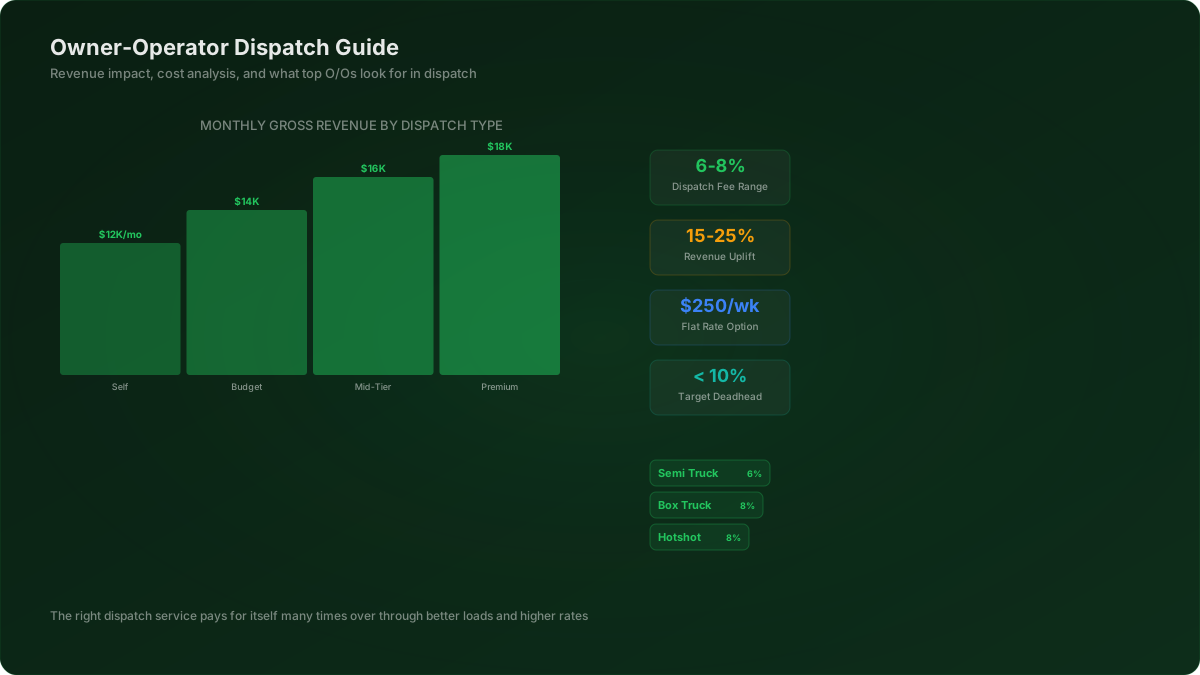
The highest-earning owner-operators in the industry almost universally use some form of dispatch support. They've done the math: the dispatch fee generates far more in additional revenue than it costs. A dispatcher who consistently finds loads paying $0.30-0.50 more per mile than you'd find yourself pays for themselves many times over.
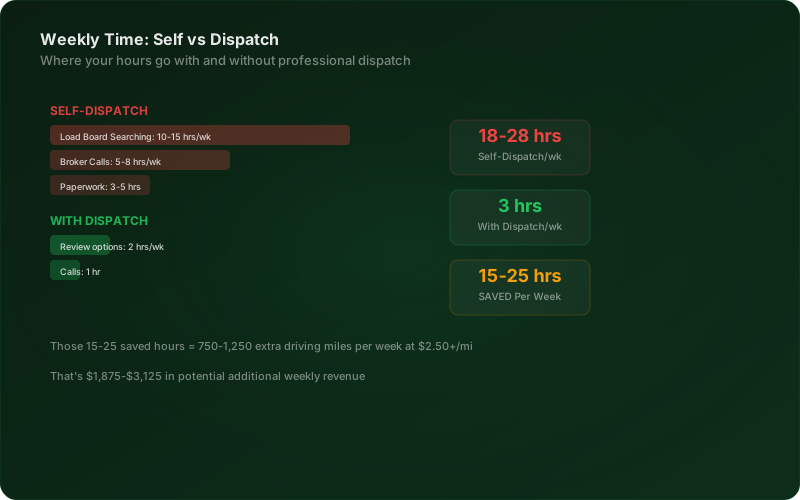
Beyond the financial math, there's the quality-of-life factor. Self-dispatching means 15-25 hours per week on load boards, phone calls, rate negotiations, and paperwork — hours that could be spent driving revenue miles, resting, or with family. The Bureau of Transportation Statistics reports that the US trucking industry moved over 11.46 billion tons of freight in 2023, and demand continues to climb. There is no shortage of loads — the question is whether you're getting the best loads or scraping for leftovers on a load board at 7 PM.
The 2026 freight market is shaped by a few realities that make professional dispatch more valuable than ever. Spot rates have been volatile — swinging 15-25% within a single quarter in many lanes. Broker consolidation means fewer but larger brokerages controlling more freight, and they prioritize dispatchers who bring them reliable capacity over solo carriers calling cold. Meanwhile, the FMCSA continues tightening compliance requirements, adding more administrative burden to an already complex business.
Here's the bottom line: the owner-operators clearing $150,000-250,000 net per year aren't doing it by spending half their day on DAT. They're running miles while someone else handles the business side. This guide covers everything you need to know about making that work — from the math of dispatch fees to lane strategy, compliance, insurance, and eventually scaling beyond one truck. For a side-by-side comparison of dispatching yourself versus hiring a service, read our Dispatch vs. Self-Dispatch breakdown.
What Dispatch Costs — Pricing Models Explained
Dispatch pricing in the trucking industry falls into two primary models, and understanding both is critical before you sign with anyone. The wrong pricing structure can quietly cost you thousands per year. For a deeper dive into fee structures industry-wide, see our Truck Dispatch Fees Explained guide.
Percentage-Based
4-8%
Of gross load revenue. This is the industry standard and what we recommend. Your dispatcher's incentive is aligned with yours — they earn more only when you earn more.
- ✓ Aligned incentives
- ✓ No payment when you're not running
- ✓ Scales with your revenue
Flat Fee
$50-200/wk
Fixed weekly or monthly fee regardless of revenue. Can be cheaper for high-revenue trucks but doesn't incentivize the dispatcher to find top-paying loads.
- ✓ Predictable cost
- ⚠ Pays even when parked
- ⚠ No rate incentive for dispatcher
Let's run the real math on both models so you can see which one wins for your revenue level:
| Monthly Gross | 6% Fee | 8% Fee | $250/wk Flat | Better Model |
|---|---|---|---|---|
| $15,000 | $900 | $1,200 | $1,083 | Percentage (6%) |
| $20,000 | $1,200 | $1,600 | $1,083 | Flat rate |
| $25,000 | $1,500 | $2,000 | $1,083 | Flat rate |
| $30,000 | $1,800 | $2,400 | $1,083 | Flat rate |
| $35,000 | $2,100 | $2,800 | $1,083 | Flat rate |
The crossover point for a 6% fee versus $250/week flat is roughly $18,000/month gross. Below that, percentage wins. Above it, flat rate saves you money. But here's the catch most carriers miss: a flat-fee dispatcher has no financial incentive to find you the highest-paying load. Whether you gross $20,000 or $35,000, they get the same $250/week. With percentage-based, every extra dollar you earn puts money in their pocket too.
That's why we recommend percentage-based for most owner-operators, especially when you're starting out or grossing under $25,000/month. Once you're consistently above that and have an established lane network, flat rate can make sense — but only with a dispatcher who's already proven they fight for top rates.
At Truck Dispatch Experts, semi trucks pay 6% per load or $250/week flat rate, and box trucks & hotshot pay 8% per load or $350/week flat rate. No setup fees, no hidden charges, and no contracts. See our full pricing breakdown. Use the Dispatch ROI Calculator to model what dispatch would cost at your current revenue level.
Cost Per Mile & Break-Even RPM
If you don't know your cost per mile, you're flying blind. Every load decision, every lane choice, every fuel stop — it all comes back to one number: what does it cost you to move your truck one mile? Until you nail this number down, you can't tell whether a $2.50/mi load is profitable or a $3.00/mi load is worth repositioning for.
Your cost per mile has two components: fixed costs (they stay the same whether you run 5,000 or 12,000 miles) and variable costs (they change with every mile driven).
| Expense | Type | Monthly Cost | Per Mile (10K mi) |
|---|---|---|---|
| Truck Payment | Fixed | $1,500 - $2,800 | $0.15 - $0.28 |
| Insurance | Fixed | $800 - $1,500 | $0.08 - $0.15 |
| Permits & Licensing | Fixed | $100 - $200 | $0.01 - $0.02 |
| ELD & Tech | Fixed | $35 - $75 | $0.004 - $0.008 |
| Phone & Software | Fixed | $100 - $200 | $0.01 - $0.02 |
| Fuel | Variable | $5,500 - $7,500 | $0.55 - $0.75 |
| Maintenance & Repairs | Variable | $1,000 - $1,800 | $0.10 - $0.18 |
| Tires | Variable | $300 - $500 | $0.03 - $0.05 |
| Dispatch Fee (6%) | Variable | $1,200 - $1,800 | $0.12 - $0.18 |
| Tolls & Scales | Variable | $200 - $500 | $0.02 - $0.05 |
Paid-Off Truck (No Payment)
$1.20 - $1.60/mi
All-in cost per mile, no profit included
Truck With Payment ($1,800/mo)
$1.60 - $2.10/mi
All-in cost per mile, no profit included
The break-even RPM formula:
Break-Even RPM = (Monthly Fixed Costs + Monthly Variable Costs) / Monthly Miles
Let's walk through a real example. Say you run a 2021 Freightliner Cascadia pulling dry van, based in Texas, running 10,000 miles per month:
- Fixed costs: $2,535/mo (payment $1,800 + insurance $1,100/mo + permits $100 + ELD $35 + phone/software $150 − wait, let's add those up: $1,800 + $917 + $150 + $50 + $150 = $3,067)
- Variable costs at 10K miles: fuel $6,500 + maintenance $1,400 + tires $400 + dispatch 6% on $25K gross = $1,500 + tolls $350 = $10,150
- Total monthly cost: $3,067 + $10,150 = $13,217
- Break-even RPM: $13,217 / 10,000 = $1.32/mi
Every penny above $1.32/mi is profit. At $2.50/mi average RPM, you're netting $1.18/mi, or $11,800/month. At $3.00/mi, it's $16,800/month. This is why rate negotiation matters so much — a $0.20/mi improvement on every load translates to $2,000 more in your pocket every month.
Plug your actual numbers into our Cost Per Mile Calculator to find your exact break-even RPM. Know that number by heart — it should drive every load decision you make.
Lane Strategy & Reload Planning
Finding a great load is one thing. Consistently stringing together profitable loads with minimal empty miles is what separates six-figure owner-operators from those barely surviving. This is where lane strategy comes in — and it's one of the biggest advantages a professional dispatcher brings to the table.
Headhaul vs. Backhaul Economics
Every freight lane has a "headhaul" direction (where freight demand is high) and a "backhaul" direction (where trucks outnumber loads). Understanding this imbalance is the foundation of lane strategy.
| Lane | Headhaul Direction | Headhaul Rate | Backhaul Rate | Difference |
|---|---|---|---|---|
| LA → Dallas | Eastbound | $2.80 - $3.40/mi | $1.60 - $2.10/mi | 40-50% drop |
| Chicago → Atlanta | Southbound | $2.50 - $3.00/mi | $1.80 - $2.30/mi | 25-35% drop |
| NJ → Miami | Southbound | $2.40 - $2.90/mi | $2.00 - $2.50/mi | 15-25% drop |
| Dallas → Chicago | Northbound | $2.60 - $3.10/mi | $1.90 - $2.40/mi | 25-30% drop |
Triangle Routing: The Pro Move
The highest-earning owner-operators don't run point-to-point and backhaul. They run triangles. Instead of LA → Dallas → LA (getting killed on the backhaul), they run LA → Dallas → Houston → LA, picking up a strong headhaul load on each leg. A good dispatcher plans 2-3 loads ahead, not just the next one.
Here's what that looks like in practice: you deliver in Dallas at 2 PM. Your dispatcher already has a short hop booked — Dallas to Houston, 240 miles, $2.90/mi, delivering at 8 AM next day. Then Houston to LA, 1,550 miles at $2.70/mi. Every leg pays headhaul rates. Your blended RPM for the triangle is $2.75/mi instead of the $2.20/mi you'd get on a straight out-and-back.
Avoiding the Deadhead Trap
Deadhead miles (driving empty) are the silent killer of owner-operator profitability. Industry average deadhead is 12-15%, but top-performing dispatched carriers run 5-8%. On 10,000 miles per month, cutting deadhead from 15% to 8% means 700 fewer empty miles — at a fuel cost of $0.65/mi, that's $455/month saved in fuel alone, plus the revenue you could've earned on those miles.
The math gets worse when you factor in tire wear, maintenance cost, and the opportunity cost of time spent driving for free. A dispatcher who keeps your deadhead under 10% is paying for their fee in deadhead savings alone. Use our Deadhead Miles Calculator to see what empty miles are actually costing you, and check our deadhead reduction guide for lane-specific strategies.
Seasonal Patterns to Know
Freight markets are seasonal, and smart lane strategy shifts throughout the year. Produce season (April through August) lights up outbound freight from California, Florida, Georgia, and the Carolinas. The holiday shipping surge (September through November) drives rates up 15-30% in major distribution corridors. January and February are historically the slowest months — plan for lighter revenue. A professional dispatcher tracks these patterns and repositions you ahead of seasonal surges rather than reacting after rates have already peaked. See our Seasonal Freight Calendar for month-by-month lane guidance.
Rate Negotiation Tactics
Rate negotiation is the single highest-leverage skill in trucking. The difference between accepting the first rate a broker posts and negotiating effectively can easily be $0.30-0.60 per mile — which translates to $3,000-6,000 per month on 10,000 miles. This is the area where professional dispatch delivers the biggest ROI.
How Professional Dispatchers Negotiate
When your dispatcher calls a broker, they're not just asking "what's the rate?" They're running a multi-step process:
- Market context check — Before calling, they check DAT Trendlines and other rate data to know what the lane is actually paying. They never negotiate blind.
- Competing offers — They have 3-5 load options on the table simultaneously. This gives them legitimate leverage: "I have a truck in Dallas that could take your load, but I also have a $3.10 offer going to the same area."
- Timing leverage — Loads that haven't been covered by 2-3 PM the day before pickup get desperate. Brokers will pay a premium to avoid telling their shipper the load isn't covered.
- Relationship capital — A dispatcher who sends a broker 20 reliable trucks per month gets a different conversation than a solo carrier calling cold. The broker knows the dispatcher's trucks show up, deliver on time, and don't cancel. That reliability is worth money.
- Accessorial billing — Most carriers forget to negotiate (or even ask for) detention pay, layover fees, TONU charges, lumper reimbursement, and stop-off fees. Your dispatcher tracks these and bills for every one.
When to Push Back on a Broker
Not every load is worth fighting over. But there are clear signals that a rate can be pushed higher:
- The load has been posted for 6+ hours — If it's still on a board at 4 PM, the broker is getting nervous. Push for 10-20% above posting.
- Pickup is tomorrow morning — Next-day pickups with no truck assigned pay a premium. The broker's alternative is telling their shipper they failed.
- It's a specialty load — Hazmat, oversize, temperature-controlled, or any load requiring special equipment or endorsements has fewer available trucks. Negotiate accordingly.
- The lane is historically strong — If you know the lane usually pays $2.80/mi and they're offering $2.30/mi, call it out directly. Data-backed negotiation beats feelings every time.
For a deeper playbook on rate negotiation, including scripts and real-world examples, read our complete Rate Negotiation Tips for Carriers guide.
Benefits Beyond Load Finding
Many carriers think dispatch is just about finding loads. In reality, a good dispatch service impacts every aspect of your owner-operator business. The carriers who treat dispatch as a "load finding service" miss the bigger picture — and the bigger value.
Higher Revenue Per Mile
Professional negotiation consistently secures rates $0.30-0.50/mi above what most O/Os get themselves. On 10,000 monthly miles, that's $3,000-5,000 more per month. Over a year, that's $36,000-60,000 in additional gross revenue — far more than the dispatch fee.
Less Deadhead
Dispatchers plan your next load before you deliver your current one. This dramatically reduces empty miles — we target under 10% deadhead for all carriers. Cutting deadhead from 15% to 8% saves $5,000-8,000 annually in fuel and wear alone.
Paperwork Handled
Rate confirmations, BOLs, PODs, invoicing, factoring communication — your dispatcher manages all documentation. That's 8-12 hours per week you get back. Time you can spend driving revenue miles or actually resting during your off-hours.
Market Intelligence
Dispatchers see the entire freight market daily. They know which lanes are hot, when rates surge seasonally, and where to position your truck for maximum earning potential. This isn't information you can get from a load board — it comes from handling hundreds of loads per week.
Broker Relationships
Established dispatchers have relationships with hundreds of brokers built over years. These relationships mean first access to premium loads before they hit the boards, better payment terms, and priority booking when capacity is tight. You can't build this network alone while driving full-time.
Detention & Accessorial Pay
Many owner-operators don't collect detention pay or accessorial charges they're entitled to. Your dispatcher tracks every minute of detention, every extra stop, every lumper fee — and bills for all of it. This alone can add $500-1,500/month in revenue most self-dispatchers leave on the table.
Cash Flow Management
Good dispatchers work with factoring companies and quickpay programs to keep your cash flowing. They ensure paperwork is submitted correctly and on time so payments aren't delayed. Consistent cash flow prevents the #1 cause of owner-operator failure: running out of money waiting for checks.
Strategic Home Time
You set your home time preferences, and your dispatcher plans loads that get you home when you need to be there — without the stress of finding a load that happens to go your way. This is huge for quality of life and family relationships.
Want to see the full financial picture? Our Dispatch ROI Calculator lets you model the exact revenue impact based on your equipment, miles, and current rates. Most owner-operators find the ROI is 3-5x the fee paid. For a longer analysis of whether dispatch is worth it for your situation, read Is Truck Dispatch Worth It?
Fuel Strategy & IFTA Management
Fuel is your single largest operating expense — typically 30-40% of total costs. At $3.50-4.00/gallon diesel and 6-7 MPG, you're spending $0.50-0.67 per mile just on fuel. A 10% improvement in fuel efficiency or strategy saves you $500-700 per month. That's real money, and it doesn't require finding better loads or negotiating harder — just being smarter about where and how you buy fuel.
Fuel Buying Strategy
Not all diesel is priced equally. Fuel prices can vary $0.40-0.80 per gallon within the same state depending on whether you're filling up at a highway travel center or a truck stop 5 miles off the interstate. Here are the rules experienced owner-operators follow:
- Use a fuel optimization app — Tools like GasBuddy, Mudflap, and TruckPark show real-time diesel prices along your route. Saving $0.15/gallon on a 150-gallon fill saves $22.50 per stop.
- Buy fuel in low-tax states — Fuel taxes vary dramatically by state. Filling up in Mississippi ($0.188/gal tax) versus California ($0.579/gal tax) saves $0.39 per gallon. On 150 gallons, that's $58.50.
- Use fuel discount programs — Pilot Flying J, Love's, and TA/Petro all offer fuel discount cards. Typical savings: $0.05-0.15/gallon. With a fuel card that offers $0.10/gal discount, you save $1,500-2,000 per year.
- Fuel strategically on your route — Don't wait until you're almost empty and have to take whatever price is available. Plan fuel stops at the cheapest locations along your route, buying more where it's cheap and less where it's expensive.
IFTA Basics Every O/O Must Know
IFTA (International Fuel Tax Agreement) is the fuel tax reporting system for trucks operating across state lines. If you drive in more than one state (which is virtually every OTR owner-operator), you must be IFTA-registered. Here's the short version:
- You report miles driven and fuel purchased in each state, every quarter
- States where you drove a lot but bought little fuel — you'll owe tax
- States where you bought a lot of fuel but drove few miles — you'll get credit
- Filing deadlines: April 30, July 31, October 31, January 31
- Late filing = penalties + interest (typically $50 base penalty per quarter, plus $5/month per jurisdiction)
Pro Tip: IFTA Tax Credits
Many owner-operators overpay IFTA because they lose fuel receipts. Every lost receipt means you can't claim fuel purchased in that state, which reduces your credit and increases your net tax owed. Keep every fuel receipt — use a receipt scanning app and photograph them immediately. A shoebox full of faded receipts at quarter-end is a recipe for lost money. Also remember: fuel bought at a truck stop with a fuel card provides automatic receipt records, which is another reason to use fuel cards.
Use our IFTA Tax Calculator to estimate your quarterly filing, and read the full IFTA Filing Guide for a step-by-step walkthrough. Use our Fuel Cost Calculator to estimate your fuel costs on any given route.
Maintenance Planning & Cost Control
Breakdowns don't just cost you the repair — they cost you the loads you can't haul while you're sitting in a shop. A $2,000 roadside repair might cost you $4,000-6,000 in lost revenue when you factor in 2-3 days of downtime. Preventive maintenance isn't optional — it's the cheapest form of insurance you can buy.
Preventive Maintenance Schedule
Every truck and engine has manufacturer-recommended service intervals. Here's a general schedule for a typical Class 8 tractor:
| Service | Interval | Cost | Skip It & Risk |
|---|---|---|---|
| Oil & Filter Change | Every 15,000-25,000 mi | $250 - $400 | Engine damage ($15,000-30,000) |
| Fuel Filter | Every 25,000-30,000 mi | $80 - $150 | Injector failure ($3,000-6,000) |
| Air Filter | Every 30,000-50,000 mi | $50 - $100 | Reduced fuel efficiency, turbo damage |
| Coolant Service | Every 300,000 mi or 3 years | $200 - $400 | Head gasket failure ($5,000-8,000) |
| Transmission Service | Every 100,000-150,000 mi | $300 - $600 | Transmission rebuild ($5,000-10,000) |
| Brake Adjustment/Inspection | Every 25,000-30,000 mi | $100 - $250 | OOS violation + accident liability |
| Full Brake Job (All Axles) | Every 250,000-350,000 mi | $2,000 - $4,000 | DOT violation, unsafe operation |
| DPF Cleaning | Every 200,000-300,000 mi | $300 - $600 | Derate, limp mode ($1,000+ roadside) |
| Annual DOT Inspection | Every 12 months | $100 - $200 | Cannot legally operate |
Tire Management
Tires are your second-largest maintenance expense after engine-related services. A full set of 18 tires (steer, drive, trailer) costs $4,000-7,000 depending on brand and quality. Here are the rules for maximizing tire life and safety:
- Check pressure weekly — Under-inflated tires wear faster, reduce fuel efficiency by 0.5-1%, and are the #1 cause of blowouts. Invest in a good tire pressure gauge.
- Rotate and match — Keep matching tires on the same axle. Mismatched tires cause uneven wear and can fail DOT inspection.
- Retread drive and trailer tires — Quality retreads cost 30-50% of new tires and are perfectly legal and safe for drive and trailer positions. Never retread steer tires.
- Budget $0.03-0.05 per mile — Set aside this amount from every load for tire replacement. On 120,000 annual miles, that's $3,600-6,000 — right in line with actual replacement costs.
Budgeting Per Mile for Maintenance
The smartest owner-operators set aside a maintenance reserve from every load. The standard rule: $0.10-0.18 per mile for general maintenance and $0.03-0.05 per mile for tires. On 10,000 monthly miles, that's $1,300-2,300/month going into a dedicated maintenance fund. When the $5,000 repair hits (and it will), you pay cash from the fund instead of putting it on a credit card at 25% interest or being forced off the road.
DOT Compliance Essentials
Compliance isn't the most exciting topic, but it's the one that can shut your business down overnight. A single out-of-service (OOS) violation means you're parked until the issue is fixed — losing $500-1,500 per day in potential revenue. A pattern of violations tanks your CSA score, which makes brokers refuse to work with you (many have a CSA threshold they won't book carriers above). The FMCSA doesn't mess around — they have the authority to revoke your operating authority entirely.
CSA Scores: What They Are and Why They Matter
The Compliance, Safety, Accountability (CSA) program tracks your safety performance across seven BASICs (Behavioral Analysis and Safety Improvement Categories):
Unsafe Driving
Speeding, texting, reckless driving, improper lane change. Points stay on your record for 24 months.
Hours-of-Service
Driving beyond your 11-hour limit, falsifying logs, ELD violations. This is the most common violation category.
Driver Fitness
Invalid CDL, expired medical certificate, missing endorsements. Easy to prevent — just keep your paperwork current.
Vehicle Maintenance
Brake defects, tire issues, light problems, fluid leaks. This is what gets caught at roadside inspections.
Controlled Substances
Drug and alcohol violations. Even a single positive test can end your career. Random testing is mandatory.
Hazmat Compliance
Only applies if you haul hazmat. Placarding, documentation, and handling violations.
Inspection Readiness Checklist
You will get inspected. It's not a question of if, it's a question of when. Level 1 inspections (full truck and driver inspection) take 45-90 minutes and check everything. Here's what to keep ready at all times:
- CDL and medical certificate — Valid, not expired, correct class and endorsements
- Vehicle registration — Current for both tractor and trailer
- Insurance card — Proof of coverage, not expired
- IFTA decals — Current year, displayed on both sides of the cab
- ELD logs — Current and for the past 7 days (8 days total)
- Annual DOT inspection sticker — Not expired
- Daily DVIR (Driver Vehicle Inspection Report) — Filled out for today
- Shipping documents — BOL for current load
- Safety equipment — Fire extinguisher (charged), three reflective triangles, spare fuses
ELD Compliance
Electronic Logging Devices have been mandatory since December 2019 (with full enforcement). Your ELD must be registered with the FMCSA, properly installed, and functioning at all times. Common violations: operating with a malfunctioning ELD (you get 8 days to fix it before going OOS), failure to transfer logs to an inspector, and unassigned driving time. Pick a reliable ELD from the FMCSA-registered device list and keep it updated.
Medical Certificates
Your DOT physical (medical certificate) is valid for 2 years, or 1 year if you have certain conditions like hypertension or diabetes. Keep a copy in your truck and make sure it's registered with your CDL state. An expired medical certificate invalidates your CDL — meaning you're technically driving without a license. Set calendar reminders 60 days before expiration.
Use our DOT Compliance Checklist to audit your compliance status right now. It takes 5 minutes and could save you from a costly violation.
Insurance & Risk Management
Insurance is your second-largest fixed expense after your truck payment, and it's non-negotiable. The FMCSA requires specific minimum coverage to maintain your operating authority, and most brokers require more than the federal minimums. Here's what you need, what it costs, and how to manage it.
Required and Recommended Coverage
| Coverage Type | FMCSA Minimum | What Brokers Want | Annual Cost | Required? |
|---|---|---|---|---|
| Primary Liability | $750,000 | $1,000,000 | $5,000 - $12,000 | Yes — FMCSA |
| Cargo Insurance | Not required* | $100K - $250K | $1,000 - $3,000 | Required by brokers |
| Physical Damage | Not required | N/A | $1,500 - $4,000 | Required by lenders |
| Bobtail/NTL | Not required | N/A | $400 - $800 | Recommended |
| Occupational Accident | Not required | N/A | $150 - $400/mo | Recommended |
| Umbrella/Excess | Not required | Some require | $1,000 - $3,000 | Recommended |
*FMCSA does not specifically require cargo insurance for most motor carriers, but almost every broker and shipper requires proof of cargo coverage before they'll book you a load.
Understanding Each Coverage Type
Primary Liability covers damage you cause to other people and property in an accident. This is the big one — the FMCSA minimum for general freight is $750,000, but virtually every broker requires $1,000,000. Hauling hazmat? The minimum jumps to $5,000,000 for certain commodities. This is not where you cut corners.
Cargo Insurance covers the freight you're hauling if it's damaged, lost, or stolen. Most brokers require $100,000 minimum, and many shippers want $250,000. If you haul high-value goods (electronics, pharmaceuticals), you may need specialty cargo coverage.
Physical Damage covers repair or replacement of your own truck. If you have a loan or lease, your lender requires this. If you own your truck outright, it's optional but recommended for any truck worth more than $20,000.
Bobtail/Non-Trucking Liability (NTL) covers you when you're driving your truck without a trailer attached and not under dispatch. Running to the shop, driving to the fuel station, heading home — your primary liability doesn't cover these movements if you're leased to a carrier.
Occupational Accident is essentially your workers' comp equivalent as an owner-operator. If you're injured in an accident and can't drive, this pays your medical bills and replaces lost income. Without it, a serious injury means both medical debt and zero income simultaneously.
How to Lower Your Insurance Costs
- Maintain a clean driving record — No accidents or moving violations for 3+ years gets you the best rates
- Install a dash cam — Many insurers offer 5-10% discounts for front-facing cameras
- Increase your deductible — Raising your deductible from $1,000 to $2,500 can save 10-20% on premiums
- Shop every renewal — Get 3-5 quotes every year. Insurance loyalty rarely pays in trucking
- Build authority history — Rates drop significantly after 2 years of clean operation under your own authority
- Consider higher liability limits — Counterintuitively, jumping from $1M to $2M liability often costs only 15-25% more and opens you to premium loads requiring higher coverage
For new authority holders expecting higher initial rates, see our New Authority Checklist which covers insurance requirements in detail alongside everything else you need before hauling your first load.
Scaling From 1 Truck to a Fleet
Every owner-operator eventually asks the question: "Should I add another truck?" The answer depends on whether you're running profitably enough with one truck, whether you have the financial reserves to survive the cash flow hit of scaling, and whether you're ready to transition from driver to business manager. Scaling too fast is the second-most common reason trucking companies fail (after undercapitalization at startup).
When You're Ready for Truck #2
Before adding a second truck, hit all of these benchmarks:
12-18 Months Profitable
You've run your single truck profitably for at least a year, through all seasons. You know your cost per mile, your best lanes, and your revenue patterns. One good quarter doesn't mean you're ready.
$20K-30K Business Reserves
Cash in your business account — not personal savings. Truck #2 will need insurance down payment ($2,000-4,000), possible truck down payment ($5,000-15,000), and operating float for the first 30-60 days until revenue flows. Plus an emergency fund for both trucks.
Proven Lane Network
You have consistent freight in lanes you know well. Adding a second truck means you need double the loads — make sure the demand exists. Your dispatcher should confirm that they can support another truck in your equipment type.
Reliable Driver Prospect
If you're not driving both trucks yourself (and you shouldn't), you need a driver you trust. Bad drivers cause accidents, damage equipment, get violations, and quit without notice. Finding the right driver is harder than finding the right truck.
Management Time Available
Two trucks means managing a driver, handling additional paperwork, monitoring compliance for two DOT numbers' worth of inspections, and dealing with twice the potential problems. Are you ready to spend 10-15 hours/week managing instead of driving?
Clear Financial Model
Know exactly what truck #2 needs to gross per month to cover: driver pay (typically 25-30% of gross), additional insurance ($8,000-15,000/yr), truck payment, fuel, maintenance, and your profit margin. If the math doesn't work at realistic revenue levels, don't scale.
Fleet Dispatch vs. Solo Dispatch
When you have 2-5 trucks, your dispatch needs change fundamentally. Solo dispatch focuses on maximizing one truck's revenue. Fleet dispatch focuses on maximizing total fleet utilization — sometimes that means one truck takes a slightly lower-paying load so the fleet as a whole runs more efficiently.
A fleet dispatcher coordinates multiple trucks, looks for relay opportunities (driver A drops a trailer in Nashville, driver B picks it up and continues to Atlanta), manages driver schedules and home time, and ensures compliance across all units. This is significantly more complex than solo dispatch. If your current dispatch service handles fleets, confirm they have the bandwidth and systems to manage multiple trucks under your MC. If they don't, it may be time to level up to a fleet-focused dispatch service.
For fleet-specific strategies and dispatch considerations, see our Small Fleet Dispatch Guide.
The Financial Jump From 1 to 2
Here's what most carriers don't expect: truck #2 is less profitable per truck than truck #1 in the first 6-12 months. You're now paying a driver (25-30% of that truck's gross), carrying additional insurance, and dealing with the inevitable learning curve of a new driver. Expect truck #2 to net 40-60% of what truck #1 nets you personally for the first year.
The math gets better at 3-5 trucks when you can negotiate volume insurance discounts, get better fuel card rates, and your dispatcher has more flexibility to optimize loads across the fleet. But you have to survive the 1-to-2 transition first. The carriers who make it follow one rule: don't add truck #2 until truck #1 can financially carry both trucks for 60 days if truck #2 generates zero revenue.
Choosing the Right Dispatch Service
The dispatch industry has exploded in recent years, and the quality gap between the best and worst services is enormous. A great dispatcher can add $30,000-60,000 to your annual gross revenue. A bad one can cost you money, damage your reputation with brokers, and waste months of your time. Here's how to evaluate any dispatch service before you commit.
The 8-Point Evaluation Framework
- Equipment specialization — Does the dispatcher know your trailer type inside and out? A dry van dispatcher shouldn't be handling your flatbed. Ask how many trucks of your equipment type they currently dispatch. If it's fewer than 5, they may not have the lane knowledge or broker relationships specific to your equipment.
- No long-term contracts — Any service confident in its quality won't lock you into a 6-12 month contract. If they need a contract to keep you, that's a red flag. You should be free to leave with 1-2 weeks notice, max.
- Transparent pricing with no hidden fees — You should know exactly what you're paying. Watch for "administrative fees," "technology fees," "setup fees," or other add-ons beyond the stated percentage. Get the full fee structure in writing before you start.
- References from similar operators — Ask to speak with 2-3 current carriers running similar equipment in similar regions. If they can't or won't provide references, walk away.
- Communication style and availability — Some dispatchers communicate primarily via app or text, others prefer phone. Find a match for your preference. Also critical: what are their hours? If you deliver at 9 PM and need a reload, is someone available? 24/7 availability isn't a luxury — it's a necessity for OTR carriers.
- Rate negotiation track record — Ask what average RPM they achieve for trucks similar to yours. Compare that to current market rates on DAT Trendlines. If they can't tell you a specific number, they're not tracking performance.
- Compliance support — Does the dispatch service help with compliance reminders, paperwork tracking, or DOT readiness? The best services proactively alert you to expiring documents and upcoming filing deadlines.
- Technology and reporting — Can you see your loads, revenue, and performance data in real-time? A dispatcher who sends you a load and nothing else isn't giving you the visibility you need to run your business. Look for services that provide dashboards, weekly reports, or at minimum clear load-by-load accounting.
Red Flags That Should Make You Walk Away
- Guaranteed rates that sound too good — "We guarantee $3.50/mi on every load" is either a lie or they're marking up loads and skimming the difference. No one can guarantee rates in a dynamic freight market.
- Upfront payments or large deposits — Legitimate dispatch services don't charge $500-2,000 upfront. They earn from percentages or flat fees on actual loads hauled.
- They want your carrier packet and MC authority access immediately — A dispatcher needs certain documents to work with you, but be cautious about giving MC authority login credentials. Some shady operators have used carrier identities to double-broker loads.
- They can't explain their process — If you ask "How do you find loads for my equipment type?" and get vague answers, they probably don't have a real process. Good dispatchers can walk you through their exact workflow.
- Negative reviews about payment or honesty — Check Google reviews, Facebook groups, and trucking forums. Isolated complaints are normal; a pattern of carriers saying they were overcharged or misled is a dealbreaker.
For a comprehensive framework with a scoring rubric you can use to compare dispatch services side by side, read our How to Choose a Dispatch Company guide. And for an industry-wide comparison of dispatch companies and what they charge, check out Best Truck Dispatch Companies.
Related Resources
- Dispatch Fees Explained — Understand what you pay and what you get from a dispatch service
- How to Get Loads for Trucks — Finding profitable freight beyond load boards
- New Authority Dispatch Guide — Everything new authorities need to know about working with dispatch
- How to Choose a Dispatch Company — Side-by-side scoring rubric for comparing dispatch services
- Dispatch ROI Calculator — Calculate whether professional dispatch pays for itself with your numbers
- Company Driver vs Owner-Operator — Not sure about going independent? Compare the paths
Truck Dispatch Experts
Published Feb 10, 2025 · Updated Mar 2, 2026