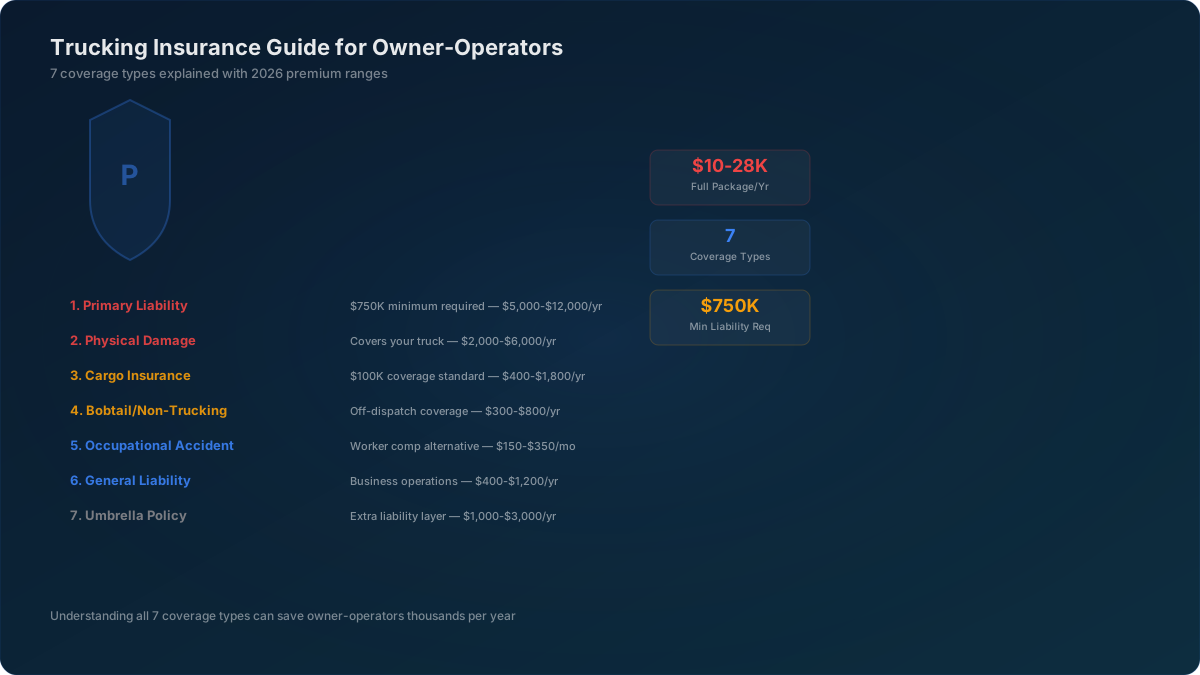
Short answer: a single-truck owner-operator with a clean record and two or more years of authority is typically quoted about $7,200 – $17,500 a year ($600 – $1,458 a month) for the three coverages that matter day to day — $1M primary liability, cargo and physical damage. Add bobtail/non-trucking liability, occupational accident, general liability and a $1M umbrella and the full package runs about $10,300 – $28,000 a year. A brand-new authority is commonly quoted 20–40% above those numbers. Federal law only requires $750,000 in liability for general freight (49 CFR 387.9) — but brokers will not load you under $1,000,000.
Premium ranges on this page are typical market quotes owner-operators report — not a survey, not a dataset we collected. Use them as a planning baseline and get three real quotes before you budget. Federal figures are cited to the Code of Federal Regulations and listed in Sources.
How Much Does Trucking Insurance Cost for an Owner-Operator?
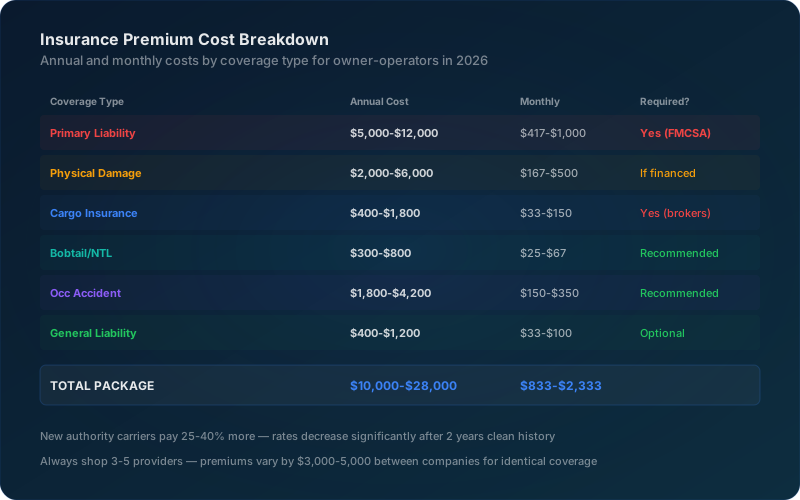
The table below is the shape of a typical single-truck quote: a clean driving record, two or more years of operating history, dry van or reefer general freight, one power unit. It is an order-of-magnitude planning baseline built from the ranges owner-operators commonly report, not a rate filing and not our own book of business.
Renewal pricing through the first half of 2026 has been the hardest small carriers have faced in years. If your renewal is coming up, treat these numbers as the floor rather than the expectation — the nuclear-verdict, reinsurance and CSA-repricing pressures pushing quotes above this baseline are broken down in the 2026 trucking insurance renewal shock.
| Coverage type | Annual premium | Monthly cost | Required? |
|---|---|---|---|
| Primary liability ($1M) | $5,000 – $10,000 | $417 – $833 | Yes (FMCSA filing) |
| Physical damage | $1,000 – $4,000 | $83 – $333 | If financed or leased |
| Cargo ($100K–$250K) | $1,200 – $3,500 | $100 – $292 | Broker requirement |
| Bobtail / non-trucking liability | $400 – $1,000 | $33 – $83 | If leased on |
| Occupational accident | $1,800 – $6,000 | $150 – $500 | Recommended |
| General liability | $400 – $1,500 | $33 – $125 | Varies by shipper |
| Umbrella / excess ($1M) | $500 – $2,000 | $42 – $167 | Some contracts |
Core three (liability + cargo + physical damage)
$7,200 – $17,500/yr
$600 – $1,458 per month
All seven coverages
$10,300 – $28,000/yr
$858 – $2,333 per month
Both cards are the column sums of the table above. Premiums vary with state of domicile, operating radius, cargo type, equipment value and driving record, so a real quote can land outside these ranges in either direction.
Why is trucking insurance so expensive for a new authority?
Underwriters have no loss history to price against, so they price the unknown. New authorities are commonly quoted 20–40% above the ranges above — on the core three coverages that works out to roughly $8,640 – $24,500 in year one. The largest single drop most owner-operators ever see comes after two clean years, which is the reason year-one discipline pays for itself. Build the number into your startup budget with the new authority cost calculator, and into your rate floor with the cost per mile calculator.
What Insurance Does FMCSA Actually Require?
Exactly one coverage is federally mandated for a general freight carrier: public liability. The limits live in the schedule at 49 CFR 387.9, and they turn on what you haul and what the truck weighs — not on how many trucks you run.
| What you haul | Vehicle | Minimum limit |
|---|---|---|
| Property, non-hazardous | For-hire, 10,001 lbs GVWR or more | $750,000 |
| Property, non-hazardous | For-hire, under 10,001 lbs GVWR | $300,000 |
| Oil and the hazardous materials listed in 49 CFR 172.101 | For-hire and private | $1,000,000 |
| Division 1.1/1.2/1.3, Division 2.3 Hazard Zone A, Division 6.1 PG I Hazard Zone A, Class 7 highway route controlled quantities | For-hire and private | $5,000,000 |
Is $750,000 enough? Legally, for general freight, yes. Commercially, no. Broker carrier packets almost universally set $1,000,000 as the entry price, so a carrier sitting at the federal minimum is compliant and close to unbookable. Carry $1M.
Which filings does your insurer make?
Your insurance company files the public liability certificate with FMCSA on Form BMC-91, or BMC-91X where more than one insurer aggregates the limits (49 CFR 387.313(a)(3)). You cannot file it yourself and your authority will not activate until FMCSA accepts it. Separately, 49 CFR 387.7(d) requires the MCS-90 endorsement (or an MCS-82 surety bond) to be kept at your principal place of business.
Correction worth knowing: cargo insurance is not filed with FMCSA by a general freight carrier. The cargo filing — a Form BMC-34 certificate or a Form BMC-83 surety bond — applies to household goods motor carriers, at $5,000 for loss on any one vehicle and $10,000 per occurrence (49 CFR 387.301(b) and 387.303(c)). If you haul general freight, expect no cargo filing to appear on your FMCSA record — and expect every broker to ask for a cargo certificate anyway.
How many days notice before a policy can be cancelled?
Two separate clocks, and confusing them is how carriers get caught out. Between you and your insurer, cancellation requires 35 days written notice from either side (49 CFR 387.7(b)(1)). The filing on record with FMCSA cannot be cancelled until 30 days after FMCSA receives written notice on Form BMC-35 for liability or BMC-36 for cargo (49 CFR 387.313(d)). When that notice matures, your proof of insurance is gone, FMCSA revokes the authority, and you cannot legally haul until a new filing is accepted. A non-payment cancellation started today is therefore not an abstract risk — it is a dated event on a federal record.
The full application-to-first-load sequence, including where insurance sits on the critical path, is in the new authority dispatch guide.
The 7 Types of Trucking Insurance Explained
Not every owner-operator needs all seven. You do need to know what each one does, because the gaps between them are where uncovered losses live. Cost figures below are the same market estimates as the table above.
Primary liability (the only federally required policy)
Primary liability covers bodily injury and property damage you cause to other people in a crash. It is the coverage the FMCSA insurance filing is about. It does not cover your own truck or the freight on it — those are separate policies.
Federal minimum vs what brokers accept
$750,000 for general freight at 10,001 lbs GVWR or more (49 CFR 387.9) — and $1,000,000 before a broker will contract with you. The gap between the two numbers is the single most common misunderstanding new authorities have about insurance.
Hazmat sits at $1M or $5M depending on class, oil at $1M, and household goods movers fall under the same $750K property minimum as general freight — but movers additionally carry the cargo-security filing obligation at 49 CFR 387.301(b) that general freight carriers do not.
Typical annual cost: $5,000 – $10,000 for general freight; more for hazmat or a new authority.
Physical damage (comprehensive & collision)
Physical damage repairs or replaces your truck and trailer. Collision covers crash damage; comprehensive covers theft, fire, vandalism and weather. A lender or lessor will require it because it protects their collateral.
Own the truck outright and it becomes a pure financial decision. If another driver totals your truck, their carrier may take months to pay and may not carry enough to cover it — and a truck sitting in a shop earns nothing while its fixed costs keep running. Raising the deductible is the usual way to cut this line without dropping the coverage.
Typical annual cost: $1,000 – $4,000, driven by the declared value and age of the equipment and by your deductible.
Cargo insurance
Cargo covers the freight itself against damage, theft or loss in transit. For general freight it is a commercial requirement rather than a federal one — FMCSA takes no cargo filing from you, but brokers and shippers will not tender a load without a certificate.
$100,000 is the limit most broker packets specify; reefer produce and pharmaceutical work, and high-value flatbed freight, routinely call for more. Set the limit against the value of what you actually haul, not against the packet minimum.
Watch out: cargo policies commonly exclude specific commodity classes — refrigerated goods, electronics, alcohol, tobacco and pharmaceuticals among them — unless the policy is endorsed for them. Hauling an excluded commodity means zero coverage on that load. Read the declarations page and make your agent walk you through the exclusions line by line.
Typical annual cost: $1,200 – $3,500 at $100K–$250K limits; reefer and high-value freight cost more.
Bobtail & non-trucking liability
Bobtail covers the tractor when you are driving it without a trailer for business purposes. Non-trucking liability (NTL) covers personal use when you are not under dispatch. Both exist to close the gap a leased-on driver has, because the carrier you are leased to only covers you while you are under their dispatch — the moment you drop the trailer and head for the house, you are outside it.
Under your own authority, your primary liability generally follows the truck whenever you are operating it for the business, so this line matters much less. Get your agent to confirm in writing how your specific policy treats off-dispatch driving before you either buy or skip it. Working through a lease agreement? The trade-offs are laid out in how to lease on to a carrier.
Typical annual cost: $400 – $1,000 for the pair; many insurers bundle them.
Occupational accident
As an independent contractor you sit outside anyone's workers compensation. Occupational accident (OA) is the contractor equivalent: medical expenses, temporary and permanent disability, and accidental death benefits for work-related injury.
The Owner-Operator Independent Drivers Association (OOIDA) sells members-only occupational accident coverage in $500,000, $1 million and $2 million plans — one of several ways independent contractors close the workers-comp gap. If you are leased on, read the lease first: some packages already include OA and you may be paying for it through a settlement deduction.
Typical annual cost: $1,800 – $6,000 depending on the benefit level.
General liability
General liability (GL) covers your business for non-driving claims — someone injured at your premises, damage you cause while on a customer's site, advertising injury. It is standard business insurance most LLCs carry regardless of industry; if you have not decided on an entity yet, start with LLC vs sole proprietor for trucking.
For a one-truck operation run from home it is the least critical of the seven. It becomes relevant when you have premises, employees or public contact — and some shippers and brokers require it as part of vendor qualification.
Typical annual cost: $400 – $1,500 for $1M coverage; often discounted when bundled.
Umbrella / excess liability
An umbrella sits on top of your primary limits. Carry $1M primary and take a $2.5M claim and the umbrella answers the $1.5M above your primary; without it, that gap is yours personally.
A $1M umbrella over a $1M primary gives $2M of total liability capacity, which is how carriers meet the $2M-plus requirements some high-value shippers and government contracts impose without buying a $2M primary. Why those requirements keep climbing is the subject of nuclear verdicts in trucking.
Typical annual cost: $500 – $2,000 for $1M of excess capacity.
Box Truck and Hotshot Insurance: What Changes
The federal filing follows gross vehicle weight rating, not the name of the equipment. At 10,001 lbs GVWR or more hauling non-hazardous property, a box truck or a hotshot rig faces the same $750,000 minimum as a Class 8 tractor (49 CFR 387.9). A for-hire operation running only vehicles under 10,001 lbs GVWR files at $300,000 instead (49 CFR 387.303(b)(1)). Most box trucks, and most hotshot setups once a loaded gooseneck is behind them, sit above that line.
So the compliance picture is the same, and so is the $1M broker expectation. What genuinely differs is the parts of the premium tied to your equipment and freight: physical damage is priced off the declared value of the unit, and cargo off what rides on it. Neither of those makes a smaller truck automatically cheap — a hotshot running high-value machinery can carry a heavier cargo line than a dry van.
Costing out either startup properly? See the box truck business guide and how to start a hotshot business, both of which put insurance alongside the rest of the fixed costs.
What Determines Your Premium: 8 Underwriting Factors
Underwriters price a defined set of risk factors. Knowing which ones you control is the difference between accepting a renewal and negotiating it.
Driving record (MVR and PSP)
The heaviest factor by far. Insurers pull your Motor Vehicle Record and your PSP report — FMCSA's Pre-Employment Screening Program file of roadside inspection and crash history. Moving violations push a quote up; an at-fault accident is the most expensive single event on a record, and quotes commonly come back at or near double the prior premium.
Operating history and authority age
New authorities are commonly quoted 20-40% above established carriers because there is no loss history to price against. The biggest drop most owner-operators ever see comes after two clean years.
Equipment age and value
Newer equipment costs more on physical damage because it is worth more. Older equipment can cost more on liability if it lacks collision mitigation, lane departure warning and automatic emergency braking.
Operating radius
Local and regional operations generally price below long-haul because exposure scales with miles and with the number of jurisdictions you touch.
Cargo type
General dry freight is the cheapest to cover. Hazmat, pharmaceuticals, electronics, alcohol and other high-value or high-theft commodities cost more because the loss severity is higher. Reefer adds spoilage risk on the cargo line.
CSA score and safety record
FMCSA's Compliance, Safety, Accountability scoring is built from roadside inspections and violations, and underwriters read it. A deteriorating profile raises premiums or closes markets entirely — the repair path is in our guide to fixing a bad CSA score.
Deductible
Higher deductibles buy lower premiums, and physical damage is where the trade is usually made. Ask your agent to quote each deductible step so you are comparing real numbers rather than a rule of thumb — and only take the step if you can fund the deductible on a bad week.
State of domicile
Insurance is regulated state by state and the litigation environment varies with it. Large, litigious, high-traffic states — Florida, Texas, California and New Jersey are the ones agents raise most often — sit at the expensive end, while low-density states such as Idaho, Iowa and the Dakotas tend to sit at the cheaper end. Treat that as agent-reported experience rather than a rate filing, and get quotes before you assume it applies to you.
Two of those factors are inspection-driven. If yours are moving the wrong way, start with how to fix a bad CSA score and how to pass a DOT inspection.
How to Lower Your Trucking Insurance Without Dropping Coverage
You do not have to accept the renewal your current insurer sends. These are the levers that actually move a commercial trucking quote, in rough order of how much they tend to matter.
Re-shop the policy every single year
Appetite shifts constantly — the underwriter who wanted your profile last year may not want it now, and vice versa. Get quotes from several trucking-specialised agents at every renewal. It is the highest-yield hour of admin in the business, and the only way to know whether your current price is competitive is to make someone else bid against it.
Take the deductible step, if you can fund it
Moving your physical damage deductible up a step lowers the premium. Ask for the quote at each deductible level rather than guessing at the saving, and only take the step if you can write the cheque on a bad week — a deductible you cannot fund is not a saving, it is a deferred problem.
Bundle the policies with one carrier
Most trucking insurers discount multi-policy accounts — liability, physical damage, cargo and bobtail on one paper. Ask for the bundled and unbundled numbers side by side so you can see the discount rather than take it on faith.
Put a dashcam in the truck
Forward-facing (and increasingly driver-facing) video is the cheapest way to win a disputed liability claim, which is why several insurers discount for it. Telematics-integrated cameras may qualify for more. Ask your agent which specific devices your carrier credits before you buy hardware on the assumption it pays for itself.
Protect the CSA profile
Fix vehicle violations before the next inspection, run clean on hours of service, and prep for roadside. An improving safety profile is the concrete thing your agent can put in front of an underwriter at renewal.
Complete a recognised defensive driving course
Programmes such as the Smith System and National Safety Council courses are widely recognised by underwriters and some insurers credit them. Confirm the credit with your carrier before you pay for the course.
Use an agent whose book is majority trucking
A generalist agent will either overprice you or miss coverage you need. Ask any prospective agent to name the underwriters they place trucking business with, and how many of them they will approach for your profile.
Check association programmes
OOIDA runs members-only insurance programmes, and other industry associations negotiate group arrangements. Worth a quote comparison, not an automatic buy.
Pay annually rather than monthly where you can
Monthly plans are premium finance, and finance carries a cost — ask for the total-cost-of-payments figure alongside the monthly figure so you can see it. If the annual payment is out of reach today, set the monthly amount aside in a dedicated account and pay in full next renewal.
Build clean operating history
Nothing else on this list moves the number as much as two clean years does. If you are a new authority, the discipline you keep in the first 24 months is what buys the third-year renewal.
Premium is only half the equation. The other half is whether the revenue is there to pay it, which is where cash flow and rate discipline come in — see the freight factoring guide and trucking tax deductions (insurance premiums are a deductible business expense).
6 Insurance Mistakes That Cost Owner-Operators Money
Across the carriers we dispatch, the same insurance mistakes come up repeatedly. Each one costs either premium, uncovered loss, or downtime while authority is sorted out.
Underinsuring cargo to save premium
Carrying a $100K cargo limit while regularly hauling more than that is a self-funded gap. Match the limit to the freight you actually book, not to the broker's minimum.
Letting coverage lapse, even briefly
A cancellation notice on file with FMCSA matures on a schedule (30 days after FMCSA receives it, per 49 CFR 387.313(d)) and takes your authority with it. Reinstatement costs you loads and follows you into the next renewal conversation. If you are parked for a season, talk to your agent about how to stay filed rather than dropping coverage.
Not reading the exclusions
Reefer breakdown, unattended vehicle theft, commodity exclusions, radius restrictions and named-driver limitations are all common. The declarations page is the document that decides whether a claim gets paid.
Buying the cheapest quote without comparing coverage
A cheaper policy that excludes half your freight types is not cheaper. Compare limits, deductibles and exclusions side by side, then compare price.
Reporting a claim late
Most policies require notice as soon as practicable, and many name a specific window — check your declarations page for yours. Notify the insurer even when the damage looks minor or the fault looks like someone else's; deciding whether it is a claim is their job.
Not updating the policy when operations change
New commodity, extra truck, wider radius, a hired driver — each one can put you outside your policy parameters, and operating outside them can void coverage. A reefer carrier who takes a flatbed load without the endorsement has no cargo coverage on that load.
How to Choose a Trucking Insurance Provider
Price is the easiest thing to compare and the least useful on its own. Here is what to evaluate alongside it:
- Trucking specialisation — the agent should be able to name the underwriters they place with, explain the BMC-91 filing without looking it up, and structure coverage around how you actually run.
- Claims handling — ask other owner-operators and your dispatch service how claims went, not how quoting went. A truck sitting in a shop earns nothing while its fixed costs keep running, so the speed of a first response is worth real money.
- Filing turnaround — your insurer files the BMC-91 or BMC-91X liability certificate with FMCSA (49 CFR 387.313(a)(3)). General freight carriers file nothing for cargo. Ask how fast they file and get the answer before you bind, because that filing is on your authority's critical path.
- Down payment and payment terms — down payment requirements vary widely between carriers, and for a new authority with tight cash that can decide the deal on its own. Ask for the down payment, the instalment schedule and the total cost of paying monthly versus annually.
- Financial strength — check the insurer's AM Best rating. An insurer that fails cannot pay your claims.
Starting authority for the first time? The new authority dispatch guide covers the filing sequence, and how to start a trucking business puts insurance next to the rest of your startup costs. If year one is already underway, the first year owner-operator guide covers what usually breaks first.
Insurance Timeline for a New Authority
If you are applying for MC authority for the first time, insurance is the item on the critical path. Here is the order to do it in.
Get quotes before you file for authority
Shop insurance before you send FMCSA your application. Your authority cannot activate until an accepted liability filing is on file, so quoting early means the paperwork is not what holds you up. Get quotes from at least three agents whose book is majority commercial trucking.
Bind the policy and let your insurer file
Choose an insurer, pay the down payment and bind. Your insurer — not you — files the liability certificate with FMCSA on Form BMC-91 or BMC-91X (49 CFR 387.313(a)(3)). General freight carriers file nothing for cargo; the BMC-34 cargo certificate applies to household goods carriers. Ask the agent how quickly they file, and get the answer before you pay.
FMCSA processes the filing while the protest period runs
FMCSA matches the filing to your MC number. In parallel, interested persons have 10 days from the date your application is published in the FMCSA Register to file a protest (49 CFR 365.115). Check your FMCSA account to confirm the filing was accepted — if it was rejected, your insurer has to re-file.
Authority activates — keep the COI in the truck
With the liability filing accepted, the BOC-3 process agent designation complete and the protest period closed, your authority goes active and you can legally haul. Keep a current certificate of insurance in the truck; brokers and shippers will ask for it before they tender a load.
How Dispatch Affects What You Pay for Insurance
Dispatch does not set your premium, but it moves several of the inputs underwriters price:
- Fewer empty miles — exposure scales with miles driven, and deadhead is exposure that earns nothing.
- Loads that match your policy — booking freight your cargo policy excludes creates a zero-coverage load you will not discover until a claim is denied.
- Documentation — clean BOLs, delivery receipts and a written communication trail are what settle disputes in your favour.
- Staying away from bad freight — double-brokered loads and unvetted brokers generate exactly the claims and non-payment fights you do not want on your record. See double brokering protection.
Sources
Every federal figure on this page traces to the sections below. Premium ranges are market estimates and are labelled as such. Last checked against the CFR on 12 August 2026.
- 49 CFR 387.9 — schedule of public liability limits ($750,000 / $1,000,000 / $5,000,000).
- 49 CFR 387.303 — filing limits, including $300,000 for vehicles under 10,001 lbs GVWR and the $5,000 / $10,000 household goods cargo limits.
- 49 CFR 387.301(b) — the cargo security filing applies to household goods motor carriers.
- 49 CFR 387.313 — Forms BMC-91, BMC-91X, BMC-34, BMC-83, and the 30-day cancellation notice on Forms BMC-35 / BMC-36.
- 49 CFR 387.7 — 35 days written notice to cancel; MCS-90 endorsement kept at the principal place of business.
- 49 CFR 365.115 — 10-day protest period running from publication in the FMCSA Register.
- OOIDA member insurance — $500,000, $1 million and $2 million occupational accident plans.
- FMCSA insurance filing requirements — agency guidance on what must be on file before authority activates.
Related Resources
- Trucking Business & Operations — the full hub this guide belongs to, from authority through bookkeeping
- 2026 Trucking Insurance Renewal Shock — why quotes are climbing and how to fight a bad renewal
- New Authority Dispatch Guide — the filing sequence and the first 90 days of revenue
- How to Start a Trucking Business — insurance in the context of total startup cost
- Freight Factoring Guide — the cash flow that makes an annual premium payable
- Nuclear Verdicts in Trucking — the liability trend behind rising limits
- New Authority Cost Calculator — put your insurance number into a startup budget
- Dispatch Pricing — what dispatch costs by equipment type, including box truck and hotshot