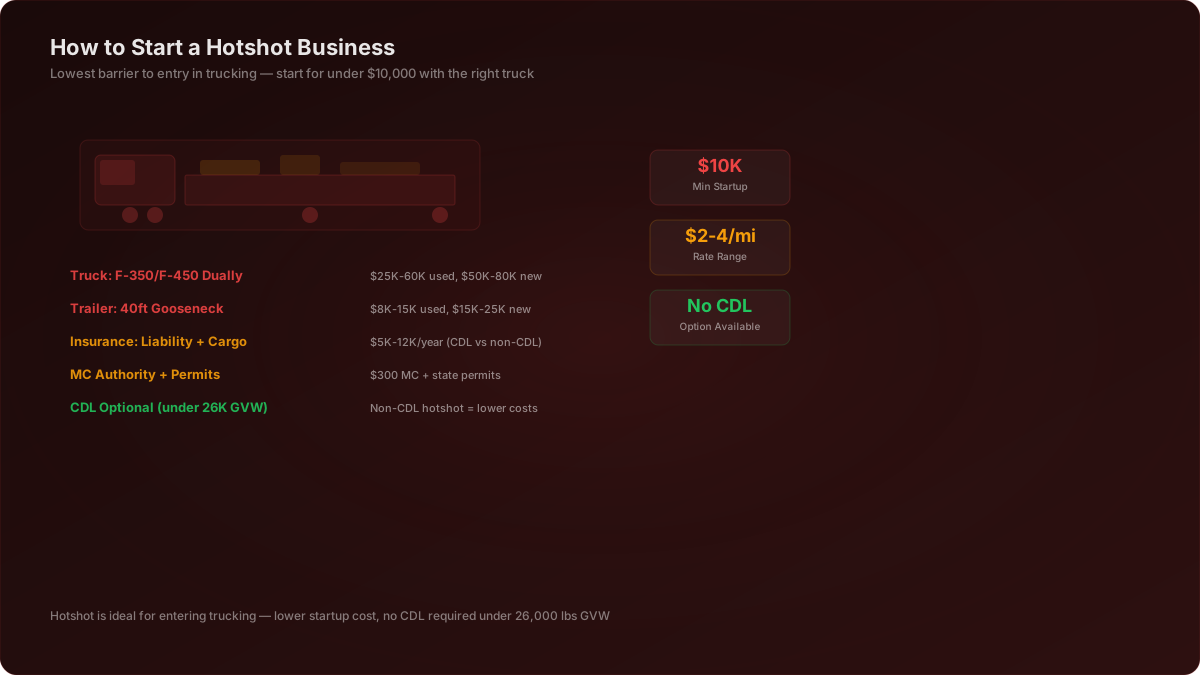
How Do You Start a Hotshot Trucking Business?
To start a hotshot trucking business you register as a motor carrier with FMCSA, insure the operation, and haul freight on a flatbed behind a heavy-duty pickup. The federal filing fees are fixed and total $346 — $300 for the operating authority application and $46 for Unified Carrier Registration. The USDOT number itself is free. Everything expensive is equipment and insurance, which you have to quote yourself. You can skip the CDL only if your truck and trailer stay under 26,001 lbs, measured by actual weight as well as by the manufacturer's rating.
- Fixed federal fees
- $346 total
- CDL threshold
- 26,001 lbs combined
- You become a CMV at
- 10,001 lbs
Fee figures verified against the Electronic Code of Federal Regulations on 12 August 2026. Sources are cited section by section throughout this guide.
What Is Hotshot Trucking?
Hotshot trucking means hauling freight on a flatbed trailer pulled by a heavy-duty pickup (Class 3–5) instead of a semi tractor-trailer (Class 8). The name comes from the oilfield, where a "hotshot" was a time-critical delivery — pipe, fittings or equipment that could not wait for a full truckload carrier.
Today it covers a much wider range of freight: construction materials, farm equipment, machinery, partial and LTL loads, expedited freight, and still plenty of oilfield work. The typical setup is a one-ton dually pulling a 40-foot gooseneck flatbed.
The appeal is capital. A pickup and a gooseneck cost less to buy and less to fuel than a tractor and a 53-foot trailer, you can park the rig at home, and if you stay under 26,001 lbs you do not need a CDL. For current equipment pricing see our truck and trailer price guide; we deliberately do not restate equipment prices here, because a second undated number on a second page is how readers end up budgeting off stale figures.
The tradeoff is revenue per load. You carry less freight per trip than a semi, so your margin per load is thinner and your cost discipline has to be better. That is the whole business in one sentence.
Hotshot is one of three low-capital entry routes we cover. If you are still choosing, compare it against starting a box truck business and starting a trucking business with a semi.
How Much Does It Cost to Start a Hotshot Business?
Startup cost splits cleanly in two. One half is set by federal regulation and is the same for everyone — you can look it up, and we have. The other half is market-priced, moves constantly, and any article that hands you a total is guessing.
| Item | Fee | Authority |
|---|---|---|
| USDOT number | No fee | No USDOT issuance fee appears in the 49 CFR 360.3T(f) schedule |
| MC operating authority application | $300 | 49 CFR 360.3T(f), Part I: Licensing, item (1) |
| Unified Carrier Registration (0–2 vehicles) | $46 | 49 CFR 367.50, Table 1, bracket B1 — registration years from 2025 onward |
| BOC-3 process agent designation | No federal fee | Required by 49 CFR 365.107(a)(6); the charge is set by the private process agent you hire |
| Total federal filing fees | $346 | $300 operating authority + $46 UCR |
The UCR fee is set per registration year by rulemaking. $46 is the 0–2 vehicle bracket under 49 CFR 367.50, which governs registration years beginning in 2025 and each year after. Check the current bracket before you file.
What we will not put a number on. The truck, the gooseneck, your insurance premium, securement gear and your operating cash cushion are the four-and-a-half figures that dominate your startup budget — and all of them are quoted, not published. Insurance in particular swings by state, driving record, radius of operation and how long your authority has been active. We dispatch hotshot carriers daily and we still would not tell you your premium without seeing a quote.
Build your own total instead of copying one. Our new authority cost calculator walks the line items, and the truck payment calculator turns a purchase price, term and rate into the monthly number that actually hits your cash flow.
Budget operating capital before your first load, not after. You will run fuel, insurance and maintenance for weeks before a broker pays an invoice. Payment terms and the cost of accelerating them are covered in our freight factoring guide — read it before you assume load revenue will carry you from day one.
How Do You Get MC Authority for a Hotshot Business?
Hotshot requires the same FMCSA motor carrier authority as a semi operation. There is no hotshot licence and no hotshot registration — same USDOT number, same MC authority, same process.
- 1
Get your USDOT number and apply for operating authority ($300)
Apply through FMCSA's Unified Registration System. The USDOT number carries no filing fee; the operating authority application is $300 under 49 CFR 360.3T(f), Part I: Licensing, item (1). The fee is not refunded if the application is denied or withdrawn.
- 2
Watch the clocks that start at publication
A summary of your application is published in the FMCSA Register (49 CFR 365.107(b)). Three deadlines run from that publication date, not from approval: protests are due within 10 days (49 CFR 365.203), your evidence of financial responsibility is due within 20 days (365.107(a)(5)), and your BOC-3 is due within 90 days (365.107(a)(6)). Miss the insurance filing and the application stalls.
- 3
File your BOC-3 designation of process agents
The form's actual title is Designation of Agents — Motor Carriers, Brokers and Freight Forwarders; the industry shorthand "blanket of coverage" is not the regulatory name. It names a process agent who can accept legal service on your behalf in each state you operate in, and it is required by 49 CFR 365.107(a)(6). There is no federal fee — process agents set their own price, so compare a few current published rates rather than trusting a figure in an article.
- 4
Buy insurance — and know which limits are law and which are contract
Only one of the coverages a broker will demand is a federal minimum. 49 CFR 387.9, Table 1, sets public liability at $750,000 for a for-hire carrier hauling non-hazardous property in a vehicle of 10,001 lbs or more. The $1,000,000 auto liability, $100,000 cargo and general liability limits you keep seeing are broker and shipper contract requirements, not law — Part 387 contains no general liability requirement at all, and it mandates cargo insurance only for household goods carriers, at $5,000 per vehicle and $10,000 per occurrence (49 CFR 387.303(c)). Carry the broker limits anyway, because without them you cannot get on a carrier packet. See our owner-operator insurance guide and get several written quotes — premiums for a brand-new authority vary too much to estimate.
- 5
Complete Unified Carrier Registration ($46)
UCR is an annual registration for interstate motor carriers. The 0–2 vehicle bracket is $46 under 49 CFR 367.50, Table 1, bracket B1, the schedule that governs registration years beginning in 2025 and after. Brackets step up sharply — 3–5 vehicles is $138 — so register the fleet size you actually run.
- 6
Get your DOT medical card (and a drug consortium if you hold a CDL)
49 CFR 391.41(a)(1)(i) requires medical certification for anyone operating a commercial motor vehicle, and requires the driver to carry the original or a copy of the certificate when on duty. The exception that lets a driver leave the card at home applies only to CDL and CLP holders whose certification is on file with the state, so a non-CDL hotshot driver must physically carry it. Drug and alcohol testing under Part 382 attaches to CDL requirements (49 CFR 382.103(a)(1)), so a non-CDL operation is outside it. If you do hold a CDL and employ only yourself, 382.103(b) requires you to be in a random testing pool of two or more covered employees — which is the entire reason consortiums exist.
- 7
Register for IFTA if your combination qualifies
Most loaded hotshot combinations do. See the IFTA section below for the rule most hotshot guides get wrong, then use our IFTA filing guide and IFTA calculator for the quarterly mechanics.
Use the waiting period productively: get the truck and trailer inspection-ready, buy securement gear, open the business bank account and set up bookkeeping. Our new authority dispatch guide sequences the first 90 days, and LLC vs sole proprietor covers the entity decision you should make before the authority activates, not after.
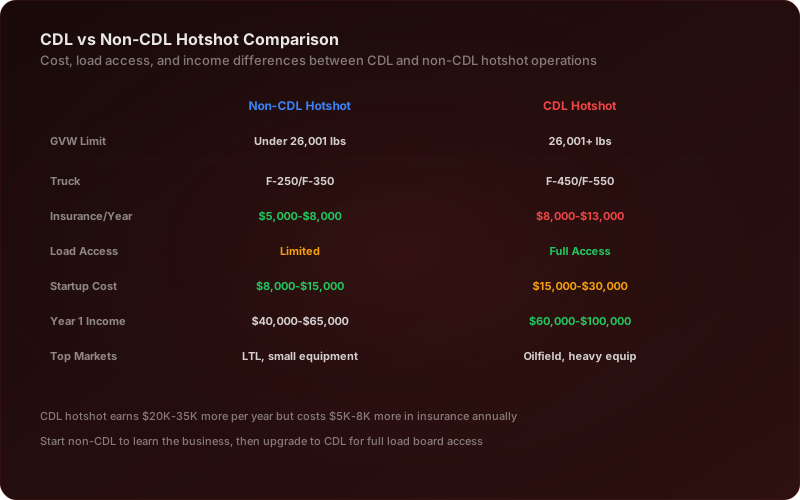
Do You Need a CDL for Hotshot Trucking?
You need a Class A CDL once your combination reaches 26,001 lbs and the trailer is over 10,000 lbs. Most hotshot guides describe this as a door-sticker test. It is not, and the difference is the single most expensive misunderstanding in this business.
49 CFR 383.5 defines gross combination weight rating as the greater of the value on the manufacturer's FMVSS certification label or the sum of the ratings or the actual weights of the power unit and towed unit, whichever produces the highest value. The Group A definition then applies at 26,001 lbs of "gross combination weight rating or gross combination weight ... whichever is greater", when the towed unit is over 10,000 lbs of rating or actual weight.
Two things follow. First, actual scaled weight counts — a rig rated at 26,000 lbs that crosses a scale at 27,000 lbs is a Group A commercial motor vehicle and its driver needs a CDL. Second, the trailer must be over 10,000 lbs for Group A to attach at all, a condition most hotshot guides never mention.
The non-CDL setup, stated honestly: a one-ton dually rated at 14,000 lbs paired with a 40ft gooseneck rated at 12,000 lbs is rated at exactly 26,000 lbs — one pound under the line. That is the most common hotshot configuration, and it is worth being blunt about what it means: you have a one-pound rating margin and no loading margin at all. Because actual combined weight also counts under 383.5, a single overweight load makes you a Group A CMV at the scale, with no CDL in your pocket. Scale your loads.
If you go CDL: heavier oilfield pipe, heavy equipment and steel open up, and a heavier truck stops being a compliance risk. Since 7 February 2022 there is no self-study route to a first Class A — 49 CFR 380.600 made entry-level driver training mandatory, and 380.603 requires theory plus behind-the-wheel instruction from a provider listed on FMCSA's Training Provider Registry. Budget for a registered school by getting current quotes locally.
Our advice: start non-CDL, learn the freight, and upgrade when you are turning down profitable loads on weight rather than because a spec sheet says so.
Do Hotshot Trucks Need an ELD and Follow Hours of Service?
Usually yes on both, and the widely repeated "under 26,001 lbs you are ELD-exempt unless you haul hazmat" is simply not a rule. It conflates the CDL threshold with the ELD threshold, and hazmat has nothing to do with ELD applicability.
Here is the actual chain. 49 CFR 390.5 makes any vehicle of 10,001 lbs or more used in interstate commerce a commercial motor vehicle. A 26,000-lb hotshot rig clears that bar several times over. And 49 CFR 395.8(a)(1)(i) requires a motor carrier operating commercial motor vehicles to install and require each driver to use an ELD.
There are only two realistic exits, and neither mentions 26,001 lbs or hazmat:
- The non-CDL short-haul exception at 49 CFR 395.1(e)(2). It exempts you from 395.3(a)(2), 395.8 and 395.11 — but only if you operate a property-carrying CMV that does not require a CDL, stay within a 150 air-mile radius of your normal work reporting location, return to that same location at the end of each duty tour, do not drive after the 14th hour on more than 5 days of any 7 or after the 16th hour on more than 2 days of any 7, and your carrier keeps accurate time records for 6 months.
- The manual RODS allowance at 395.8(a)(1)(ii)(A): you may log on paper if you complete a record of duty status on no more than 8 days in any 30-day period, in a driveaway-towaway operation, or in a vehicle manufactured before model year 2000.
Read the return-to-base condition twice. It is where most hotshot operators lose the short-haul exception without realising it: a one-way run that ends 300 miles from home does not qualify, no matter how many air miles the pickup was. And note the record-keeping duty sits on the carrier as a 6-month time record — it is not a driver log grid.
Do Hotshot Trucks Need IFTA?
More often than most hotshot guides admit — including the version of this page we replaced. The usual advice is that a two-axle pickup under 26,001 lbs is exempt. That reads the wrong clause.
The IFTA Articles of Agreement (11 March 2026 edition) define a qualified motor vehicle at R245 in three alternatives, and any one of them is enough:
- R245.100 — two axles and a gross or registered gross weight over 26,000 lbs; or
- R245.200 — three or more axles, regardless of weight; or
- R245.300 — used in combination, when the weight of the combination exceeds 26,000 lbs gross or registered gross vehicle weight.
A pickup pulling a gooseneck is a combination, so R245.300 is your clause, not R245.100. A dually plus a tandem-axle gooseneck is also a four-axle combination, which R245.200 catches regardless of weight. And the test is gross or registered weight, not the manufacturer's rating — registering the truck at a higher weight can trigger IFTA independently of what the door label says.
Practically: if your loaded truck-and-trailer combination runs over 26,000 lbs, plan on an IFTA licence and quarterly returns. Our IFTA filing guide covers base-state registration and the filing calendar, and the IFTA calculator handles the per-jurisdiction miles and gallons math.
What Truck and Trailer Do You Need for Hotshot?
Diesel and dual rear wheels. Gas engines lack the torque for sustained towing at highway speed, and single-rear-wheel trucks lack the stability and payload for commercial work behind a 40-foot gooseneck. Beyond that, resist shopping from a spec table — including ours.
Gross vehicle weight rating is configuration-dependent. It varies by cab, drivetrain and axle package within the same model line and model year. The only rating that governs your CDL question is the one printed on the FMVSS certification label of the specific truck in front of you. Read that label before you buy, and remember from the section above that actual scaled weight can override it anyway.
| Truck | Engine | Typical position vs 26,001 lbs combined |
|---|---|---|
| Ford F-350 DRW | 6.7L Power Stroke | Commonly configured to stay under with a standard 40ft gooseneck |
| RAM 3500 DRW | 6.7L Cummins | Commonly configured to stay under with a standard 40ft gooseneck |
| Ford F-450 DRW | 6.7L Power Stroke | Usually over once a gooseneck of any size is attached |
| RAM 4500 DRW | 6.7L Cummins | Usually over once a gooseneck of any size is attached |
| Ford F-550 DRW | 6.7L Power Stroke | Over — plan on a Class A CDL |
| RAM 5500 DRW | 6.7L Cummins | Over — plan on a Class A CDL |
Directional guidance only. Confirm against the FMVSS certification label on the individual truck and the trailer's own rating — those two numbers, and the scale ticket, are what an inspector uses.
The 40ft gooseneck flatbed is the standard
The gooseneck hitch sits in the truck bed over the rear axle, which distributes weight better and allows a higher payload than a bumper-pull. Forty feet is the length most brokers expect, and it stays inside normal length limits without permits. Brands with the widest dealer and parts networks include PJ Trailers, Big Tex, Diamond C, Load Trail and Kaufman.
On specs: electric brakes on both axles, LED lighting, a dovetail with fold-over ramps for equipment, and plenty of tie-down points are all reasonable buying preferences. They are preferences, not standards — the binding requirement is the securement rule below.
For current gooseneck and flatbed pricing, use our truck and trailer price guide rather than a figure quoted here.
Bumper-pull flatbed: cheaper, but it narrows your freight
Bumper-pull trailers connect to a standard receiver hitch. They cost less and are easier to hook up, but they are shorter than a 40ft gooseneck, carry less, and are less stable at highway speed. Most brokers posting longer freight expect a gooseneck. A bumper-pull can work for local construction delivery; it will limit your load options everywhere else.
Comparing deck types more broadly? See flatbed vs step deck.
Securement: learn the rule, then buy the gear
An inspector does not check whether you own a round number of straps. Two rules govern. 49 CFR 393.106(d) requires the aggregate working load limit of your tiedowns to be at least one-half the weight of the article being secured. 49 CFR 393.110 sets the minimum count by article length: one tiedown for an article 5 ft or under and 1,100 lbs or under; two if it is over 1,100 lbs at that length, or between 5 and 10 ft at any weight; two for anything over 10 ft, plus one more for every additional 10 ft or fraction.
Build your kit to satisfy those two calculations for the heaviest freight you intend to haul, then add ratchet straps, chains and binders, edge protectors and lumber tarps as working stock. Cheap straps fail inspections and fail loads.
How Much Do Hotshot Truckers Make?
We are not going to publish an income table. This page used to carry one, and its upper bounds were not physically achievable — they implied a solo operator driving several thousand miles a week, every week. A confident-looking income model is worse than no model, because people finance trucks against it.
What we can give you is the method, and one figure we have actually verified.
Work it out in five lines
- Gross revenue
- loads per week × revenue per load × weeks worked
- Fuel
- (total miles ÷ your observed mpg) × price per gallon
- Fixed costs
- insurance + truck payment + permits + phone/software
- Variable costs
- maintenance + tires + tolls + dispatch fee
- Take-home
- gross − fuel − fixed − variable − self-employment tax
The one input we can date for you: the EIA weekly U.S. on-highway diesel average was $5.257/gal for the week ending August 10, 2026, and the 2026 series has run $3.46 to $5.64 with a year-to-date average of $4.80. Check the live EIA reading before you price a lane — it moves weekly.
Run the numbers rather than reading them: the cost per mile calculator gives you the breakeven figure to reject loads against, the profit per load calculator tests an individual rate confirmation including deadhead, and the fuel cost calculator converts miles and mpg into dollars at the current price. For where diesel may head next, see our 2026 diesel price outlook.
Two costs new operators consistently under-model. Self-employment tax is levied on net earnings, and the Social Security portion stops at the annual wage base while the Medicare portion does not — so a flat percentage applied to a large net overstates it. Our trucking tax deductions guide and bookkeeping guide cover both, and the first-year owner-operator guide covers the cash-flow shape of year one.
On market rates: within hotshot freight, oilfield and expedited work generally price highest per mile, construction sits in the middle, and agricultural and LTL partial freight sit lowest. That ordering is stable; the dollar values behind it are not, and we will not print undated bands that a reader might negotiate against months later. Oilfield demand in particular tracks drilling activity, so it can fall away quickly when crude prices drop.
How Do Hotshot Drivers Find Loads?
Hotshot freight is different from van freight: more of it is partial, more of it is time-critical, and a lot of it never reaches a public board because brokers call people they already know. Four channels matter.
Load boards
DAT One, Truckstop and Direct Freight all support equipment-specific searching. We compare the two largest in DAT vs Truckstop rather than asserting relative inventory here. Boards are where you start; they should not be where you stay.
Dispatch services
A hotshot dispatcher with existing broker relationships can reach freight that never gets posted. That matters most in your first months, when you have no track record for a broker to check.
Direct shipper relationships
Oilfield supply houses, general contractors and equipment dealers all need recurring hotshot capacity. In our own dispatch experience this is the transition that separates operators who are still grinding boards in year two from those who are not. Our guide to getting loads for your truck covers the approach.
Social media groups — with a warning
Freight does get posted in trucking groups, but so does double-brokered freight. If the entity posting the load is not the entity on the rate confirmation, you may have no enforceable claim against anyone when the invoice goes unpaid. Verify the MC number, check broker credit, and get the rate confirmation in the name of the party you actually contracted with.
What Mistakes Kill Hotshot Businesses?
We dispatch for hotshot operators every day. These are the patterns we see in the ones who do not make it past year one.
Buying too much truck
A large payment on a new truck crushes cash flow in the year you have the least of it. The truck is a tool, not a status symbol. Model the payment first with the truck payment calculator.
Not knowing your cost per mile
If you cannot state your breakeven, you cannot evaluate a load. There is no universal hotshot figure to borrow — it depends on your payment, your premium, your mpg and your miles. Compute yours in the cost per mile calculator and reject anything under it.
Judging a load on its posted rate instead of its total miles
A $600 load moving 400 miles looks acceptable until you add 200 miles of deadhead getting back. That is 600 total miles for $600 — $1.00 per mile against every mile the truck actually turned, which is a very different number from the $1.50 the posting implied. Always divide by loaded plus deadhead miles; the profit per load calculator does it for you.
Starting with no operating capital
Expecting load revenue to fund week one. Broker payment terms and the cost of factoring them are covered in the freight factoring guide. Have fuel and insurance money in the bank before you dispatch.
Taking the first insurance quote
Premiums for a new authority vary widely between carriers for identical risk. Get several written quotes and compare limits and exclusions, not just the premium — see the owner-operator insurance guide.
Chasing freight instead of building a territory
Running coast to coast after the highest board rate instead of building repeat customers inside a working radius. Operators who know their lanes get called; operators who chase get whatever is left.
Treating securement as a shopping list
Buying a round number of straps rather than satisfying 49 CFR 393.106(d) and 393.110 for the freight in front of you. Civil penalty amounts are set in 49 CFR Part 386 Appendix B and adjusted annually, and roadside citations vary by state — but the load you drop is the part that ends the business.
No bookkeeping from day one
Receipts in a shoebox, reconciled at tax time. Track every mile, gallon and toll from your first load — our trucking bookkeeping guide sets up the system, and your deductions depend on it.
Signing long dispatch or lease contracts
Locking into a long dispatch term or a lease with heavy early termination fees before you know what your operation looks like. Any legitimate dispatch company — including us — should offer month-to-month terms.
Mixing personal and business money
Open a business bank account before your first load. Commingled accounts make profitability impossible to read and can undermine the liability protection you formed an entity for — see LLC vs sole proprietor.
What Does a Day in Hotshot Trucking Look Like?
A working day, not the Instagram version. Times are illustrative — the point is the shape of the day and where the regulated steps fall.
Early morning: check dispatch updates or work the boards. If you self-dispatch, budget real time for searching and calling brokers before the good freight is gone. If you use a dispatcher, your first load is already booked and you go straight to the truck.
Pre-trip inspection: tires on both truck and trailer, lights, brakes, straps and chains, fluids, hitch connection. 49 CFR 396.13 requires the driver to be satisfied the vehicle is in safe operating condition before driving, and to review and sign the last inspection report where one is required. DOT does not care that it is a pickup.
Pickup and securement: unlike van freight, you are usually present for loading and you secure the load yourself. This is where the 393.106 and 393.110 math from earlier gets applied in a yard, in the weather, under time pressure. Know it cold before you need it.
Line haul: drive, fuel, break. If you are relying on the non-CDL short-haul exception, remember it only holds on days you return to your normal work reporting location, and the obligation is a carrier time record kept for 6 months, not a driver log grid. On any day that does not qualify, you are back under 49 CFR 395.8.
Delivery and admin: unload or wait to be unloaded, get the BOL signed, send paperwork to your dispatcher or factor, post-trip inspection, log fuel receipts, and line up tomorrow. The admin tail is real and it is unpaid — which is precisely the hour a dispatcher buys back.
Sources and review status
Every fee, weight threshold and compliance requirement on this page was checked against the primary source on 12 August 2026. Regulations change; verify before you file.
- Electronic Code of Federal Regulations, Title 49 — Parts 360, 365, 367, 380, 382, 383, 387, 390, 391, 393, 395 and 396.
- IFTA Articles of Agreement, 11 March 2026 edition — section R245, qualified motor vehicle.
- U.S. Energy Information Administration — weekly on-highway diesel price, week ending August 10, 2026.
Related Resources
- Trucking Business & Operations hub — every guide on starting, financing and running a carrier
- New Authority Dispatch Guide — the first 90 days after your authority activates, in order
- How to Start a Trucking Business — the same journey with a semi instead of a pickup
- Box Truck Business Guide — the other low-capital route, if you are still deciding
- IFTA Filing Guide — base-state registration and quarterly returns
- Owner-Operator Insurance Guide — what to buy beyond the federal minimum, and how to quote it
- Cost Per Mile Calculator — know your breakeven before booking any load
- Hotshot Dispatch Services — what we do for hotshot operators, and what it costs